
Scientific Computing and Data / AIR·MS (AI Ready Mount Sinai) / AIR·MS Data Modalities
AIR·MS Data Modalities
The AIR·MS platform proudly features the following Mount Sinai and public datasets. Our team is dedicated to continuously expanding our database with additional data modalities, striving to build a comprehensive, multi-modal research resource. To help you get started with the data, we offer Quick Start guides available here. Available Datasets (PHI = Protected Health Information, De-ID = De-Identified Information):
- Mount Sinai Data Warehouse (MSDW) OMOP De-Identified (De-ID) and Protected Health Information (PHI)
- Pathology Metadata (PHI)
- Mount Sinai Million Data (PHI and De-ID)
- Electrocardiogram (ECG) Metadata (PHI)
- Intensive Care Unit (ICU) Operational Datamart (PHI)
- Radiology Image Data (PHI and De-ID)
- Radiology Notes (De-ID)
- Radiology Notes (PHI)
- Radiology Metadata (PHI)
- Electroencephalography Metadata (PHI)
- Echocardiography Metadata (PHI)
- Endoscopy Reports (PHI)
Public Datasets:
Mount Sinai Data Warehouse (MSDW) OMOP De-Identified (De-ID) and Protected Health Information (PHI)
The MSDW dataset leverages the OMOP Common Data Model. The data is comprised of clinical data extracted from Mount Sinai’s Epic Caboodle database and other ancillary systems. We offer both the identified (PHI) and de-identified (De-ID) versions of this data. 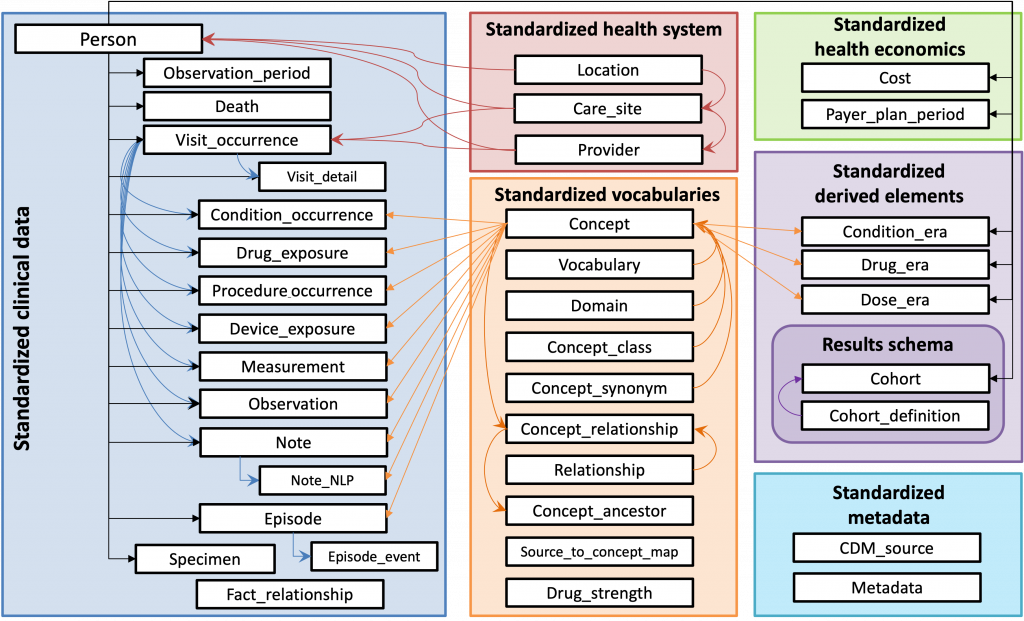
We offer both an identifiable and a de-identified version of the MSDW dataset in AIR·MS
To access the data, follow our “Getting Started” guide here: https://labs.icahn.mssm.edu/minervalab/air%E2%80%A7ms-getting-started/
MSDW OMOP identifiable (PHI) with extended attributes Current Status
Schema: CDMPHI
Data snapshot from 09/10/2025
Unique patients: 12,521,239
| Table | Record Count |
| ATTRIBUTE_DEFINITION | 0 |
| CARE_SITE | 108,613 |
| CDC_RACE_ETHNICITY_XTN | 967 |
| CDM_SOURCE | 1 |
| COHORT | 6,100,000 |
| COHORT_DEFINITION | 3 |
| CONCEPT | 11,357,728 |
| CONCEPT_ANCESTOR | 101,072,304 |
| CONCEPT_CLASS | 453 |
| CONCEPT_RELATIONSHIP | 178,331,994 |
| CONCEPT_SYNONYM | 5,190,521 |
| CONDITION_ERA | 0 |
| CONDITION_OCCURRENCE | 224,124,347 |
| COST | 0 |
| DATABASECHANGELOG | 64 |
| DATABASECHANGELOGLOCK | 1 |
| DEATH | 49,797 |
| DEVICE_EXPOSURE | 0 |
| DOMAIN | 50 |
| DOSE_ERA | 0 |
| DRUG_ERA | 0 |
| DRUG_EXPOSURE | 241,235,148 |
| DRUG_STRENGTH | 3,003,619 |
| FACT_RELATIONSHIP | 169,049,038 |
| LOCATION | 13,822,023 |
| MEASUREMENT | 1,963,710,364 |
| METADATA | 0 |
| NOTE | 251,559,257 |
| NOTE_NLP | 0 |
| OBSERVATION | 538,781,648 |
| OBSERVATION_PERIOD | 12,561,446 |
| PAYER_PLAN_PERIOD | 0 |
| PERSON | 12,521,239 |
| PROCEDURE_OCCURRENCE | 355,906,745 |
| PROVIDER | 1,372,277 |
| PROVIDER_ATTRIBUTE_XTN | 788,610 |
| RELATIONSHIP | 730 |
| SOURCE_TO_CONCEPT_MAP | 0 |
| SPECIMEN | 0 |
| VISIT_DETAIL | 0 |
| VISIT_OCCURRENCE | 230,899,469 |
| VOCABULARY | 254 |
Note: Some of the standard OMOP tables contain extension fields (starting with the prefix ‘XTN’) which contain data outside of the OMOP standard data model. Many of these XTN attributes are based on data derived directly from EPIC (i.e. codes used in EPIC rather than the standardized OMOP codes), or attributes not currently contained in the OMOP standard.
MSDW OMOP de-identified (de-id) Current Status
Schema: CDMDEID
Data snapshot from 10/20/2025
Unique patients: 12,008,581
| Table | Record Count |
| ATTRIBUTE_DEFINITION | 0 |
| CARE_SITE | 109,310 |
| CDC_RACE_ETHNICITY_XTN | 967 |
| CDM_SOURCE | 1 |
| COHORT | 3,739,597 |
| COHORT_ATTRIBUTE | 0 |
| COHORT_DEFINITION | 11 |
| CONCEPT | 11,382,893 |
| CONCEPT_ANCESTOR | 84,020,373 |
| CONCEPT_CLASS | 449 |
| CONCEPT_RELATIONSHIP | 175,957,371 |
| CONCEPT_SYNONYM | 5,190,383 |
| CONDITION_ERA | 0 |
| CONDITION_OCCURRENCE | 207,689,269 |
| COST | 0 |
| DATABASECHANGELOG | 60 |
| DATABASECHANGELOGLOCK | 1 |
| DEATH | 57,522 |
| DEVICE_EXPOSURE | 0 |
| DOMAIN | 50 |
| DOSE_ERA | 0 |
| DRUG_ERA | 0 |
| DRUG_EXPOSURE | 223,692,656 |
| DRUG_STRENGTH | 2,981,765 |
| FACT_RELATIONSHIP | 158,497,299 |
| LOCATION | 138,7824 |
| MEASUREMENT | 2,018,330,339 |
| METADATA | 0 |
| NOTE | 216,623,789 |
| NOTE_NLP | 0 |
| OBSERVATION | 398,593,907 |
| OBSERVATION_PERIOD | 12,091,204 |
| OMOP.TRACE | 0 |
| PAYER_PLAN_PERIOD | 0 |
| PERSON | 12,008,581 |
| PROCEDURE_OCCURRENCE | 331,740,865 |
| PROVIDER | 1,373,456 |
| PROVIDER_ATTRIBUTE_XTN | 787,290 |
| RELATIONSHIP | 730 |
| SCHEMA.METADATA | 0 |
| SLIDE_XTN | 2,397,874 |
| SOURCE_TO_CONCEPT_MAP | 0 |
| SPECIMEN | 0 |
| SURVEY_CONDUCT | 0 |
| VISIT_DETAIL | 0 |
| VISIT_OCCURRENCE | 208,717,628 |
| VOCABULARY | 237 |
Pathology Metadata (PHI)
The Pathology metadata aids researchers in the field of Computational Pathology. Researchers are able to query the metadata in combination with other linked data modalities to build a patient cohort, subsequently apply quantitative methods for the analysis of digital microscopy slides and relating the resulting statistical descriptors to patient outcomes. We are also working on making the digital slides available to researchers on Minerva HPC.
To access the data, follow our “Getting Started” guide here: https://labs.icahn.mssm.edu/minervalab/air%E2%80%A7ms-getting-started/
Current Status
Data Source: Powerpath
Schema: CDMPATHOLOGY
Data snapshot from 01/08/2025
Unique patients: 3,528,719
Note: Pathology reports are now available in AIR·MS and can be found in table ACC_RESULTS. The reports are broken up into sections (clinical history, final diagnosis, SNOMED coding, etc.) that can be identified by column PATH_RPT_HEADING_NAME. If you are looking for the full report, you can combine all records for with the same ACCESSION_2_ID into a single output. The column containing the free-text (ACC_RESULTS_FINDING) has been enabled with SAP HANA full-text search capabilities. Examples of how to use HANA full-text search are available in this tutorial notebook.
The following tables and attributes are available in AIR·MS:
ACCESSION
Number of records: 7,107,464
| Column Name | Comments |
|---|---|
| ACC_CATG | Case category |
| ACC_PROCESS_STEP_COMPLETED_DATE | Case finalize date / status update datetime |
| ACCESSION_2_ID | PowerPath unique case ID |
| ACCESSION_NO | Case number |
| BIRTH_DATE | Patient date of birth |
| CREATED_DATE | Case creation date |
| CURRENT_STATUS_ID | PowerPath unique identifier for a case status |
| FACILITY_CODE | Facility code |
| FACILITY_ID | PowerPath ID for the facility associated with the accession |
| FACILITY_NAME | Facility name |
| IMPORTED_CASE | One-character \”Y\” or \”N\” code indicating if the case was imported into PowerPath |
| LAST_UPDATE_DATETIME | Case finalize date / status update datetime |
| MED_REC_NO | Medical record number (EPIC MRN) |
| MRN_FACILITY_CODE | PowerPath ID for the facility that assigned the MRN |
| MRN_FACILITY_DESCRIPTION | Name of the facility that assigned the MRN |
| ORDER_NUMBER | Order number from the ordering system |
| PATIENT_AGE | The patient’s age on the case creation date |
| PATIENT_ID | PowerPath patient ID |
| PERSONNEL_2_FULL_NAME | Name of the pathologist who finalized the accession |
| PERSONNEL_2_ID | PowerPath ID for the pathologist who finalized the accession |
| PROCESS_STEP_DESCRIPTION | Case status name / description |
| VISIT_NUMBER | Encounter identifier |
ACC_ICD
Number of records: 3,548,815
| Column Name | Comments |
|---|---|
| ACC_ICD9_ID | PowerPath surrogate unique identifier for an ICD-10 code assigned to a case |
| ACCESSION_2_ID | PowerPath unique case ID |
| LAST_UPDATE_DATETIME | Case finalize date / status update datetime |
| MEDICAL_CODE | ICD-10 code assigned for billing |
| MEDICAL_CODE_ID | PowerPath surrogate unique identifier for an ICD-10 code |
ACC_SLIDE
Number of records: 14,241,494
| Column Name | Comments |
|---|---|
| ACC_BLOCK_ID | PowerPath unique block ID |
| ACC_BLOCK_LABEL | Specimen block identifier |
| ACC_PROCESS_STEP_COMPLETED_DATE | Case finalize date / status update datetime |
| ACC_SLIDE_ID | PowerPath unique slide ID |
| ACC_SPECIMEN_DESCRIPTION | Specimen source description |
| ACC_SPECIMEN_ID | PowerPath unique specimen ID |
| ACCESSION_2_ID | PowerPath unique case ID |
| BIOPSY | Boolean flag for 1 = biopsy, 0 = non-biopsy |
| COLLECTION_DATE | Specimen collection date |
| CONSULT_LABEL | Optional free text for slides of type \”consult\” |
| LAB_PROCEDURE_CODE | The procedure code |
| LAB_PROCEDURE_DESCRIPTION | The procedure description |
| LAB_PROCEDURE_ID | PowerPath unique procedure identifier |
| LAST_UPDATE_DATETIME | Case finalize date / status update datetime |
| RECV_DATE | Specimen received date |
| SLIDE_LABEL | Derived unique (business key) identifier for each slide |
| SLIDE_NO | Ordinal number of the slide from the specimen & block |
| SLIDE_TYPE | Whether the slide is stained, unstained or antibody/IHC |
| SOURCE_MATERIAL_LABEL | Derived unique (business key) identifier for each slide’s source specimen and block |
| SOURCE_REC_TYPE | Where the slide came from, either specimen or block |
| SPECIMEN_CATEGORY_ID | PowerPath specimen category ID |
| SPECIMEN_CATEGORY_NAME | The specimen category name |
| SPECIMEN_GROUPS_CODE | Specimen specialty code |
| SPECIMEN_GROUPS_ID | PowerPath specimen specialty ID |
| SPECIMEN_LABEL | Specimen identifier |
| TYPE | Whether the slide is consult or not consult |
ACC_RESULTS
Number of records: 31,193,765
| Column Name | Comments |
|---|---|
| ACC_RESULTS_FINDING | The text of the report section |
| ACC_RESULTS_ID | PowerPath unique identifier for each report section |
| ACC_RESULTS_REC_ID | sort order of result section on RTF |
| ACCESSION_2_ID | PowerPath unique case ID |
| LAST_UPDATE_DATETIME | Case finalize date / status update datetime |
| PATH_RPT_HEADING_ID | PowerPath result section heading on RTF |
| PATH_RPT_HEADING_NAME | PowerPath result section heading name |
ACC_SLIDE_IMAGESERVER
Number of records: 2,564,239
| Column Name | Comments |
|---|---|
| ACC_SLIDE_ID | PowerPath unique slide ID |
| ACC_SLIDE_IMAGESERVER_DESCRIPTION | The name of the Philips iSyntax slide image file |
| ACC_SLIDE_IMAGESERVER_ID | PowerPath unique identifier for a slide image |
| INTERNAL_SLIDE_ID | Identifier for the slide, also known as the \”barcode\” ID |
| LAST_UPDATE_DATETIME | Case finalize date / status update datetime |
| SCAN_DATE | The date on which the slide image was digitized |
Mount Sinai Million Health Discoveries Program
The current lack of diversity in genomic research data is hindering what we can learn about health and potential treatments in our global population. By enhancing the diversity of people participating in genomic research, we can advance our knowledge and discovery of human genetics for all populations. To that end, The Charles Bronfman Institute for Personalized Medicine is spearheading the effort to carry out the genetic sequencing of one million Mount Sinai patients within the next five years. This initiative, one of the largest such sequencing projects of its kind, will integrate health and research data at Mount Sinai to promote discoveries that will directly benefit our patient population. Access to the BioMe Biobank and Mount Sinai Million Biobank on HPC can be requested via the CBIPM Data and Specimen Inquiry Form. AIR·MS now features radiology metadata extracted from the Mount Sinai IRW 2.0 XNAT system (via an MSDW data pipeline). This data set is comprised of detailed DICOM (Digital Imaging and Communications in Medicine) tags associated with the medical images. These tags provide essential metadata, including patient information, imaging parameters, equipment details, and procedural context, ensuring a comprehensive understanding of each radiological study. By integrating this metadata, we enable researchers to gain deeper insights into the imaging data, facilitating advanced analyses and fostering innovations in medical imaging research.
To access the data, follow our “Getting Started” guide here: https://labs.icahn.mssm.edu/minervalab/air%E2%80%A7ms-getting-started/
The following tables and attributes are available in AIR·MS:
Mount Sinai Million / BioMe identifiable (PHI)
Current Status
Schema: CDMMSM
Data snapshot from 06/09/2025
Unique patients: 279,885
| PATIENT | Comments |
| ID | Internal ID for linking to other tables within the dataset |
| MRN | Medical Record Number (EPIC MRN – only accessible under regulatory approval) |
| MASKED_MRN | De-Identifier for combined BioMe Biobank set with Regeneron and Sema4 data |
| RGN_ID | De-identifier for first Regeneron batch regarding BioMe Biobank |
| SEMA4_ID | De-identifier for Sema4, a subset of Masked MRN ID |
| MSM_ID | De-identifier for Mount Sinai Million Biobank, a combined setoff RGN_ID and new MSM ID |
| MILLION_ID | Indicator for all consented patients with and without genomic data |
| AIR_CREATED_AT | Record creation in AIR·MS |
| AIR_UPDATED_AT | Record updated in AIR·MS |
Mount Sinai Million / BioMe de-identified (de-id)
Current Status
Schema: CDMMSMDEID
Data snapshot from 06/09/2025
Unique patients: 279,885
| PATIENT | Comments |
| ID | Internal ID for linking to other tables within the dataset |
| MASKED_MRN | De-Identifier for combined BioMe Biobank set with Regeneron and Sema4 data |
| RGN_ID | De-identifier for first Regeneron batch regarding BioMe Biobank |
| SEMA4_ID | De-identifier for Sema4, a subset of Masked MRN ID |
| MSM_ID | De-identifier for Mount Sinai Million Biobank, a combined setoff RGN_ID and new MSM ID |
| MILLION_ID | Indicator for all consented patients with and without genomic data |
| AIR_CREATED_AT | Record creation in AIR·MS |
| AIR_UPDATED_AT | Record updated in AIR·MS |
Electrocardiogram (ECG) Data (PHI)
Electrocardiogram data, derived from Mount Sinai’s Cardiology Information System, is now available in AIR·MS.
To access the data, follow our “Getting Started” guide here: https://labs.icahn.mssm.edu/minervalab/air%E2%80%A7ms-getting-started/
Current Status
Data Source: GE HealthCare MUSE Cardiology Information System
Schema: CDMECG
Data snapshot from: 04/10/2021
Unique patients: 1,961,254
The following tables and attributes are available in AIR·MS:
Number of records: 9,275,130
| PATIENT_DEMOGRAPHICS |
| PATIENT_DEMOGRAPHICS_ID (X) |
| FILE_ENTRY_ID |
| PATIENT_ID |
| PATIENTAGE |
| AGEUNITS |
| DATEOFBIRTH |
| GENDER |
| RACE |
| PATIENTLASTNAME |
| PATIENTFIRSTNAME |
Number of records: 9,168,266
| DIAGNOSIS |
| DIAGNOSIS_ID (X) |
| FILE_ENTRY_ID |
| MODALITY |
| DIAGNOSISSTATEMENT |
Number of records: 73,631,055
| LEAD_DATA |
| LEAD_DATA_ID (X) |
| FILE_ENTRY_ID |
| LEADBYTECOUNTTOTAL |
| LEADTIMEOFFSET |
| LEADSAMPLECOUNTTOTAL |
| LEADAMPLITUDEUNITSPERBIT |
| LEADAMPLITUDEUNITS |
| LEADHIGHLIMIT |
| LEADLOWLIMIT |
| LEADID |
| LEADOFFSETFIRSTSAMPLE |
| FIRSTSAMPLEBASELINE |
| LEADSAMPLESIZE |
| LEADOFF |
| BASELINESWAY |
| LEADDATACRC32 |
| WAVEFORMDATA |
Number of records: 9,610,935
| ECG_FILES |
| FILE_ENTRY_ID (X) |
| FILE_NAME |
| FILE_PATH |
| FILE_HASH |
| FILE_SIZE_BYTES |
| ACQUISITION_DATE |
| ACQUISITION_TIME |
| PROCESSING_STATUS |
| STATUS_CODE |
| NOTES_AND_COMMENTS |
| FILE_TIMESTAMP |
| AIR_CREATED_AT |
| AIR_UPDATED_AT |
| JSON_STATUS |
Number of records: 9,168,230
| MUSE_INFO |
| MUSEVERSION |
| FILE_ENTRY_ID |
Number of records: 7,757,472
| ORDER_INFO |
| ORDER_INFO_ID (X) |
| FILE_ENTRY_ID |
| HISACCOUNTNUMBER |
| ORDERTIME |
| ADMITTIME |
| ADMITDATE |
| HISLOCATION |
| BED |
| ATTENDINGMDHISID |
| ATTENDINGMDLASTNAME |
| ATTENDINGMDFIRSTNAME |
| ALTERNATEVISITID |
| HISDISPOSITION |
| ADMITSOURCE |
| PRIMARYDIAGNOSTICCODE |
| SERVICINGFACILITY |
| ADMITTINGMDHISID |
| ADMITTINGMDLASTNAME |
| ADMITTINGMDFIRSTNAME |
| CONSULTINGMDID |
| REFERRINGMDHISID |
| HOSPITALSERVICE |
| ADMISSIONTYPE |
Number of records: 9,164,220
| ORIGINAL_DIAGNOSIS |
| ORIGINAL_DIAGNOSIS_ID (X) |
| FILE_ENTRY_ID |
| MODALITY |
| DIAGNOSISSTATEMENT |
Number of records: 9,168,044
| ORIGINAL_RESTING_ECG_MEASUREMENTS |
| ORIGINAL_RESTING_ECG_MEASUREMENTS_ID (X) |
| VENTRICULARRATE |
| ATRIALRATE |
| PRINTERVAL |
| QRSDURATION |
| QTINTERVAL |
| QTCORRECTED |
| PAXIS |
| RAXIS |
| TAXIS |
| QRSCOUNT |
| QONSET |
| QOFFSET |
| PONSET |
| POFFSET |
| TOFFSET |
| ECGSAMPLEBASE |
| ECGSAMPLEEXPONENT |
| QTCFREDERICA |
Number of records: 3,613,372
| PHARMA_DATA |
| PHARMA_DATA_ID (X) |
| PHARMARRINTERVAL |
| PHARMAUNIQUEECGID |
| PHARMAPPINTERVAL |
| PHARMACARTID |
| FILE_ENTRY_ID |
Number of records: 9,649,712
| QRS_TIMES_TYPES |
| GLOBALRR |
| QTRGGR |
| FILE_ENTRY_ID |
Number of records: 9,657,368
| RESTING_ECG |
| RESTING_ECG_ID (X) |
| FILE_ENTRY_ID |
| PATIENT_ID |
| ACQUISITIONDATE |
| ACQUISITIONTIME |
| STATUS |
Number of records: 9,167,778
| RESTING_ECG_MEASUREMENTS |
| RESTING_ECG_MEASUREMENTS_ID (X) |
| FILE_ENTRY_ID |
| VENTRICULARRATE |
| ATRIALRATE |
| PRINTERVAL |
| QRSDURATION |
| QTINTERVAL |
| QTCORRECTED |
| PAXIS |
| RAXIS |
| TAXIS |
| QRSCOUNT |
| QONSET |
| QOFFSET |
| PONSET |
| POFFSET |
| TOFFSET |
| ECGSAMPLEBASE |
| ECGSAMPLEEXPONENT |
| QTCFREDERICA |
Number of records: 9,654,325
| TEST_DEMOGRAPHICS |
| TEST_DEMOGRAPHICS_ID (X) |
| FILE_ENTRY_ID |
| DATATYPE |
| SITE |
| SITENAME |
| ACQUISITIONDEVICE |
| STATUS |
| EDITLISTSTATUS |
| PRIORITY |
| LOCATION |
| LOCATIONNAME |
| ROOMID |
| ACQUISITIONTIME |
| ACQUISITIONDATE |
| CARTNUMBER |
| ACQUISITIONSOFTWAREVERSION |
| ANALYSISSOFTWAREVERSION |
| EDITTIME |
| EDITDATE |
| EDITORID |
| REFERRINGMDLASTNAME |
| REFERRINGMDFIRSTNAME |
| ACQUISITIONTECHLASTNAME |
| EDITORLASTNAME |
| EDITORFIRSTNAME |
| SECONDARYID |
| HISSTATUS |
Intensive Care Unit (ICU) Data (PHI)
The Mount Sinai ICU Datamart is the world’s first ICU data platform designed to simultaneously support research, quality improvement, and operational initiatives. It is built on a common data model that standardizes critical care medical concepts, enabling consistent interpretation and integration of data across diverse ICU settings.The Mount Sinai ICU Datamart harmonizes and delivers high-fidelity information from all Mount Sinai adult ICUs with highly granular data available from 2011 onward and refreshed weekly. Beyond serving as a comprehensive data resource, it also tracks the evolution of the health system’s critical care landscape, capturing changes in unit specialties, geographic distribution, and the addition of new ICUs. By transforming the ICU’s inherently rich data environment into a standardized, dynamic, and accessible platform, the Mount Sinai ICU Datamart empowers clinicians, researchers, and administrators to advance data-driven care, operational excellence, and clinical discovery.
To access the data, follow our “Getting Started” guide here: https://labs.icahn.mssm.edu/minervalab/air%E2%80%A7ms-getting-started/
Current Status
Schema: CDMICU
Number of patients: 103,974
Number of hospital admissions: 128,599
Number of ICU stays: 152,154
Number of clinical events and observations: 553,095,763
The following tables and attributes are available in AIR·MS:
Number of records: 128,600
| HOSP_ADMISSIONS |
| ADMISSION_LOCATION |
| ADMISSION_TYPE |
| ADMIT_PROVIDER_ID |
| AIR_CREATED_AT |
| AIR_UPDATED_AT |
| CREATED_INSTANT |
| DEATH_TIME |
| DISCHARGE_LOCATION |
| DISCH_TIME |
| ED_IN_TIME |
| ED_OUT_TIME |
| ETHNICITY |
| HADM_ID |
| HOSPITAL_EXPIRE_FLAG |
| INPATIENT_ADMIT_TIME |
| INSURANCE |
| LANGUAGE |
| MARITAL_STATUS |
| MODIFIED_INSTANT |
| RACE |
| SUBJECT_ID |
Number of records: 289,789,014
| HOSP_CHART_EVENTS |
| AIR_CREATED_AT |
| AIR_UPDATED_AT |
| CAREGIVER_ID |
| CHART_TIME |
| CREATED_INSTANT |
| HADM_ID |
| ITEM_ID |
| MODIFIED_INSTANT |
| STORE_TIME |
| SUBJECT_ID |
| VALUE |
| VALUE_NUM |
| VALUE_UOM |
| WARNING |
Number of records: 17
| HOSP_D_ITEMS |
| AIR_CREATED_AT |
| AIR_UPDATED_AT |
| CAREGIVER_ID |
| CHART_TIME |
| CREATED_INSTANT |
| HADM_ID |
| ITEM_ID |
| MODIFIED_INSTANT |
| STORE_TIME |
| SUBJECT_ID |
| VALUE |
| VALUE_NUM |
| VALUE_UOM |
| WARNING |
Number of records: 18,030
| HOSP_D_LAB_ITEMS |
| AIR_CREATED_AT |
| AIR_UPDATED_AT |
| CREATED_INSTANT |
| ITEM_ID |
| LABEL |
| MODIFIED_INSTANT |
Number of records: 263,306,749
| HOSP_LAB_EVENTS |
| AIR_CREATED_AT |
| AIR_UPDATED_AT |
| COLLECTION_INSTANT |
| CREATED_INSTANT |
| FLAG |
| HADM_ID |
| ITEM_ID |
| LAB_EVENT_ID |
| LAB_ORDER_ID |
| MODIFIED_INSTANT |
| ORDER_PROVIDER_ID |
| PRIORITY |
| REF_RANGE_LOWER |
| REF_RANGE_UPPER |
| RESULT_INSTANT |
| SPECIMEN_TYPE |
| SUBJECT_ID |
| VALUE |
| VALUE_NUM |
| VALUE_UOM |
Number of records: 1,858,853
| HOSP_LDA_EVENTS |
| AIR_CREATED_AT |
| AIR_UPDATED_AT |
| CREATED_INSTANT |
| FIRST_RECORDED_INSTANT |
| ITEM_ID |
| LDA_ID |
| LENGTH_LDA |
| MODIFIED_INSTANT |
| PLACEMENT_INSTANT |
| REMOVAL_INSTANT |
| SUBJECT_ID |
Number of records: 63
| HOSP_LDA_ITEMS |
| AIR_CREATED_AT |
| AIR_UPDATED_AT |
| CREATED_INSTANT |
| ITEM_ID |
| LABEL |
| LDA_CATEGORY |
| LDA_SUB_CATEGORY |
| MODIFIED_INSTANT |
Number of records: 104,046
| HOSP_PATIENTS |
| AIR_CREATED_AT |
| AIR_UPDATED_AT |
| CREATED_INSTANT |
| DOB |
| DOD |
| EPIC_ID |
| ETHNICITY_COMBO_ID |
| GENDER |
| MODIFIED_INSTANT |
| PRIMARY_MRN |
| RACE_COMBO_ID |
| SUBJECT_ID |
Number of records: 525,267
| HOSP_PATIENT_SERVICES |
| AIR_CREATED_AT |
| AIR_UPDATED_AT |
| ASSIGNMENT_END |
| ASSIGNMENT_START |
| CARE_UNIT |
| CARE_UNIT_ID |
| CREATED_INSTANT |
| HADM_ID |
| MODIFIED_INSTANT |
| PATIENT_SERVICE_ID |
| SUBJECT_ID |
Number of records: 839,542
| HOSP_TRANSFERS |
| AIR_CREATED_AT |
| AIR_UPDATED_AT |
| BED_ID |
| CARE_UNIT |
| CARE_UNIT_ID |
| CREATED_INSTANT |
| EVENT_TYPE |
| HADM_ID |
| IN_TIME |
| MODIFIED_INSTANT |
| OUT_TIME |
| SUBJECT_ID |
| TRANSFER_ID |
Number of records: 152,154
| ICU_ICU_STAYS |
| AIR_CREATED_AT |
| AIR_UPDATED_AT |
| CARE_UNIT_ID |
| CREATED_INSTANT |
| HADM_ID |
| IN_TIME |
| LOS |
| MODIFIED_INSTANT |
| OUT_TIME |
| STAY_ID |
| SUBJECT_ID |
Number of records: 289,789,014
| ICU_ICU_STAYS |
| AIR_CREATED_AT |
| AIR_UPDATED_AT |
| CARE_UNIT_ID |
| CREATED_INSTANT |
| HADM_ID |
| IN_TIME |
| LOS |
| MODIFIED_INSTANT |
| OUT_TIME |
| STAY_ID |
| SUBJECT_ID |
Number of records: 30
| MAPPING_CARE_UNIT |
| AIR_CREATED_AT |
| AIR_UPDATED_AT |
| CARE_UNIT_END_DATE |
| CARE_UNIT_ID |
| CARE_UNIT_NAME |
| CARE_UNIT_START_DATE |
| CATEGORY_ID |
| CREATED_INSTANT |
| HOSPITAL_ID |
| MODIFIED_INSTANT |
Number of records: 29
| MAPPING_CARE_UNIT_SERVICE_TAG |
| AIR_CREATED_AT |
| AIR_UPDATED_AT |
| CARE_UNIT_ID |
| CREATED_INSTANT |
| MODIFIED_INSTANT |
| SERVICE_TAG_END_DATE |
| SERVICE_TAG_ID |
| SERVICE_TAG_START_DATE |
Number of records: 5
| MAPPING_CATEGORY |
| AIR_CREATED_AT |
| AIR_UPDATED_AT |
| CATEGORY |
| CATEGORY_ID |
| CREATED_INSTANT |
| MODIFIED_INSTANT |
Number of records: 47
| MAPPING_EPIC_DEPARTMENT |
| AIR_CREATED_AT |
| AIR_UPDATED_AT |
| CARE_UNIT_ID |
| CREATED_INSTANT |
| DEPARTMENT_ID |
| DEPARTMENT_NAME |
| EPIC_DEPARTMENT_END_DATE |
| EPIC_DEPARTMENT_START_DATE |
| MODIFIED_INSTANT |
Number of records: 336
| MAPPING_ETHNICITY |
| AIR_CREATED_AT |
| AIR_UPDATED_AT |
| CONCEPT_LEVEL_1 |
| CONCEPT_LEVEL_2 |
| CREATED_INSTANT |
| ETHNICITY_COMBO_ID |
| MODIFIED_INSTANT |
| RACE_ETHNICITY_TERMINOLOGY_KEY |
Number of records: 189
| MAPPING_ETHNICITY_BRIDGE |
| AIR_CREATED_AT |
| AIR_UPDATED_AT |
| CATEGORY_NAME |
| CREATED_INSTANT |
| ETHNICITY_COMBO_ID |
| MODIFIED_INSTANT |
Number of records: 38
| MAPPING_GEOGRAPHIC_LOCATION |
| AIR_CREATED_AT |
| AIR_UPDATED_AT |
| CARE_UNIT_ID |
| CREATED_INSTANT |
| GEOGRAPHIC_LOCATION |
| GEOGRAPHIC_LOCATION_END_DATE |
| GEOGRAPHIC_LOCATION_START_DATE |
| MODIFIED_INSTANT |
Number of records: 8
| MAPPING_HOSPITAL |
| AIR_CREATED_AT |
| AIR_UPDATED_AT |
| CREATED_INSTANT |
| HOSPITAL |
| HOSPITAL_ID |
| MODIFIED_INSTANT |
Number of records: 85
| MAPPING_PATIENT_SERVICE |
| AIR_CREATED_AT |
| AIR_UPDATED_AT |
| CREATED_INSTANT |
| MODIFIED_INSTANT |
| PATIENT_SERVICE |
| PATIENT_SERVICE_ID |
Number of records: 298
| MAPPING_RACE |
| AIR_CREATED_AT |
| AIR_UPDATED_AT |
| CONCEPT_LEVEL_1 |
| CONCEPT_LEVEL_2 |
| CREATED_INSTANT |
| MODIFIED_INSTANT |
| RACE_COMBO_ID |
| RACE_ETHNICITY_TERMINOLOGY_KEY |
Number of records: 176
| MAPPING_RACE_BRIDGE |
| AIR_CREATED_AT |
| AIR_UPDATED_AT |
| CATEGORY_NAME |
| CREATED_INSTANT |
| MODIFIED_INSTANT |
| RACE_COMBO_ID |
Number of records: 11
| MAPPING_SERVICE_TAG |
| AIR_CREATED_AT |
| AIR_UPDATED_AT |
| CREATED_INSTANT |
| MODIFIED_INSTANT |
| SERVICE_TAG |
| SERVICE_TAG_ID |
Radiology Image Data (PHI and De-ID)
AIR·MS provides a new radiology dataset organized in a ground-up, OMOP-aligned medical imaging common data model. The currently implemented model represents DICOM studies and series and links those records to OMOP patients and concepts. The identifiable schema also stores study- and series-level DICOM attributes that are not promoted to dedicated columns while preserving nested sequence structure, repeated tags, arrays, coded values, units, and typed values.
The identifiable model contains source identifiers and other protected health information (PHI). The de-identified model removes direct identifiers, converts linked identifiers to de-identified keys, shifts patient dates and datetimes, and transforms free-text values to remove PHI.
To access the data, follow the AIR·MS “Getting Started” guide.
Current Status
Identifiable schema: CDMRADIOLOGY
De-identified schema: CDMRADIOLOGYDEID
Distinct persons with a populated study access URI: 546,136 in CDMRADIOLOGY; 541,243 in CDMRADIOLOGYDEID
Model definition: September 4, 2026
Record Counts
| Schema | Table | Required populated field | Record count | Distinct persons |
|---|---|---|---|---|
CDMRADIOLOGY |
IMAGING_STUDY |
IMAGING_STUDY_ACCESS_URI |
1,528,206 | 546,136 |
CDMRADIOLOGY |
IMAGING_SERIES |
IMAGING_SERIES_ACCESS_URI |
15,741,502 | 545,991 |
CDMRADIOLOGYDEID |
IMAGING_STUDY |
IMAGING_STUDY_ACCESS_URI |
1,510,900 | 541,243 |
CDMRADIOLOGYDEID |
IMAGING_SERIES |
IMAGING_SERIES_ACCESS_URI |
15,607,158 | 541,101 |
Model Structure
The model follows the native DICOM hierarchy:
IMAGING_STUDY
├── IMAGING_STUDY_ATTRIBUTE (PHI only)
└── IMAGING_SERIES
    └── IMAGING_SERIES_ATTRIBUTE (PHI only)
Tables
| Table | Purpose |
|---|---|
IMAGING_STUDY |
One record per imaging study, linked to the patient. |
IMAGING_SERIES |
One record per DICOM series within a study, with modality, anatomy, acquisition, equipment, and aggregate image information. |
IMAGING_STUDY_ATTRIBUTE |
Study-level DICOM attributes that are not represented as dedicated columns in IMAGING_STUDY. |
IMAGING_SERIES_ATTRIBUTE |
Series-level DICOM attributes that are not represented as dedicated columns in IMAGING_SERIES. |
Key Relationships
IMAGING_STUDY.PERSON_IDlinks an imaging study to the OMOP person record.IMAGING_SERIES.IMAGING_STUDY_IDlinks each series to its parent study.- In
CDMRADIOLOGY, each attribute table links to its owning study or series and uses a self-referencing parent attribute ID to represent nested DICOM sequences. - OMOP concept fields provide standardized mappings where available; a value of
0indicates that no mapping is available.
De-Identification Behavior
The implemented CDMRADIOLOGYDEID schema contains IMAGING_STUDY and IMAGING_SERIES. Attribute tables are available only in the identifiable CDMRADIOLOGY schema. The De-ID model applies the following rules to its implemented tables:
- Patient, study, and series identifiers are de-identified and stored as
char(64)values. - Study, series, acquisition, content, and instance-creation date/datetime values are shifted on a patient-specific basis.
- Free-text study descriptions, series descriptions, institution names, and department names are algorithmically transformed rather than retaining verbatim PHI-bearing text.
- Direct patient identifiers and source DICOM identifiers are excluded, including accession number, Study Instance UID, Series Instance UID, DICOM patient ID, patient name components, birth date, sex, and address.
- Source-system ETL keys and ETL audit fields are excluded from the De-ID model.
- Study- and series-level attribute tables, including their nested DICOM values, are not currently implemented in the De-ID schema.
Nested DICOM Tags, Sequences, and Arrays
The two PHI attribute tables use the same structural pattern. A sequence tag has its own row. Child tags reference that sequence row through PARENT_IMAGING_STUDY_ATTRIBUTE_ID or PARENT_IMAGING_SERIES_ATTRIBUTE_ID. PARENT_DICOM_TAG_PATH in the study-attribute definition and PARENT_DICOM_TAG_SOURCE_VALUE in the series-attribute definition record the human-readable path to the parent sequence, including zero-based sequence indexes. PARENT_SEQUENCE_INDEX identifies the item within the immediate parent sequence.
Arrays are distinct from sequences. IS_ARRAY = 1 indicates that a tag contains multiple scalar values, and ARRAY_INDEX records the zero-based position of each value. TAG_OCCURRENCE_NUMBER distinguishes repeated occurrences of the same tag under one parent; DICOM-compliant data normally uses the default value 1.
Values are stored in the column matching their type:
| Value column | Use |
|---|---|
VALUE_AS_NUMBER |
Integer or decimal values |
VALUE_AS_CONCEPT_ID |
Standard OMOP concept derived from a source concept |
VALUE_AS_SOURCE_CONCEPT_ID |
Custom OMOP concept representing the source value |
VALUE_AS_CODE |
DICOM coded value such as CodeValue |
SOURCE_VOCABULARY_NAME |
Coding scheme for the coded value, such as DCM, SRT, or UCUM |
VALUE_AS_STRING |
Text and other string values |
VALUE_AS_DATETIME |
Date or datetime values |
UNIT_CONCEPT_ID / UNIT_SOURCE_VALUE |
Standardized and source unit of measure |
Tables and Attributes
The implemented table definitions are listed below. IMAGING_STUDY and IMAGING_SERIES are available in both schemas. The two attribute tables are implemented only in CDMRADIOLOGY. Required status is the same in both variants for retained columns.
IMAGING_STUDY
One record per imaging study, linked to the patient.
Identifiable model: 35 columns. De-identified model: 15 columns.
| Column | Key | Required | PHI type | De-ID type | De-ID handling | Description |
|---|---|---|---|---|---|---|
IMAGING_STUDY_ID |
PK | Yes | bigint |
char(64) |
De-identified identifier; stored as char(64) |
OMOP unique ID for each patient imaging study |
PERSON_ID |
FK | No | bigint |
char(64) |
De-identified identifier; stored as char(64) |
OMOP unique ID for the patient undergoing the imaging study |
PROCEDURE_OCCURRENCE_ID |
FK | No | bigint |
char(64) |
De-identified identifier; stored as char(64) |
Reserved for a future link to the corresponding OMOP procedure occurrence; this linkage is not currently implemented |
ACCESSION_NUMBER |
— | No | varchar(128) |
— | Excluded from the De-ID model | DICOM tag (0008,0050) AccessionNumber: Unique identifier for the imaging study in the RIS/EHR system |
IMAGING_STUDY_INSTANCE_UID |
— | Yes | varchar(128) |
— | Excluded from the De-ID model | DICOM tag (0020,000D) StudyInstanceUID: Unique identifier for the imaging study assigned by the imaging equipment |
DICOM_STUDY_ID |
— | No | varchar(128) |
— | Excluded from the De-ID model | DICOM tag (0020,0010) StudyID: An identifier for the imaging study included in the DICOM header |
IMAGING_STUDY_DATE |
— | No | date |
date |
Patient-specific date/datetime shift | DICOM tag (0008,0020) StudyDate: The date on which the imaging study was performed |
IMAGING_STUDY_TIME |
— | No | time(6) |
time(6) |
Retained | DICOM tag (0008,0030) StudyTime: The time of day at which the imaging study was performed |
IMAGING_STUDY_DESCRIPTION |
— | No | nvarchar(300) |
nvarchar(300) |
Algorithmically transformed to remove PHI | DICOM tag (0008,1030) StudyDescription: The description of the imaging study |
IMAGING_STUDY_CONCEPT_ID |
FK | Yes | int |
int |
Retained | Foreign-key reference to an OMOP concept in ATHENA representing the imaging study performed, derived entirely or in part from the value in DICOM tag (0008,1030) StudyDescription; Will be zero if the value is unmapped to an OMOP concept from ATHENA |
IMAGING_STUDY_ACCESS_URI |
— | No | varchar(2000) |
varchar(2000) |
Retained | Uniform Resource Identifier (URI) describing the location from which the DICOM file can be retrieved, either on a web DICOM server (e.g., via the use of the WADO-RS DICOMweb REST API) or other repository |
MODALITIES_IN_STUDY |
— | No | varchar(100) |
varchar(100) |
Retained | DICOM tag (0008,0061) ModalitiesInStudy: A comma-separated list of DICOM modality codes for the imaging modalities used to acquire this study’s imaging series |
NUMBER_OF_SERIES |
— | Yes | int |
int |
Retained | The total number of imaging series within the imaging study, computed from the records in the imaging_series table. Note: The DICOM tag (0020,1000) SeriesInStudy was retired in 2004. |
NUMBER_OF_INSTANCES |
— | Yes | int |
int |
Retained | The total number of instances (of all SOP classes) across all the series within the imaging study, computed from the number_of_instances column in the imaging_series table. |
NUMBER_OF_IMAGES |
— | Yes | int |
int |
Retained | The total number of image instances across all the series within the imaging study, computed from the number_of_images column in the imaging_series table. |
DICOM_PATIENT_ID |
— | No | varchar(128) |
— | Excluded from the De-ID model | DICOM tag (0010,0020) PatientID: An identifier for the patient passed to the RIS from the procedure ordering system, usually a Medical Record Number (MRN) |
DICOM_PATIENT_ID_TYPE |
— | No | varchar(64) |
— | Excluded from the De-ID model | DICOM tag (0010,0022) TypeOfPatientID: A short code indicating the type of identifier used for the patient in DICOM tag (0010,0020) PatientID |
ISSUER_OF_PATIENT_ID |
— | No | nvarchar(200) |
— | Excluded from the De-ID model | DICOM tag (0010,0021) IssuerOfPatientID: An identifier for the organization that assigned the patient identifier in DICOM tag (0010,0020) PatientID |
DICOM_PATIENT_NAME |
— | No | nvarchar(1000) |
— | Excluded from the De-ID model | DICOM tag (0010,0010) PatientName: The verbatim text string of the patient’s full name as included in the imaging study’s DICOM header, formatted according to the DICOM standard with caret delimiters |
DICOM_PATIENT_LAST_NAME |
— | No | nvarchar(300) |
— | Excluded from the De-ID model | The patient’s surname or family name(s) extracted from the first caret-delimited component of DICOM tag (0010,0010) PatientName |
DICOM_PATIENT_GIVEN_NAME |
— | No | nvarchar(200) |
— | Excluded from the De-ID model | The patient’s given name(s) extracted from the second caret-delimited component of DICOM tag (0010,0010) PatientName |
DICOM_PATIENT_MIDDLE_NAME |
— | No | nvarchar(200) |
— | Excluded from the De-ID model | The patient’s middle name(s), if any, extracted from the third caret-delimited component of DICOM tag (0010,0010) PatientName |
DICOM_PATIENT_BIRTH_DATE |
— | No | date |
— | Excluded from the De-ID model | DICOM tag (0010,0030) PatientBirthDate: The patient’s date of birth as included in the imaging study’s DICOM header |
DICOM_PATIENT_SEX |
— | No | varchar(32) |
— | Excluded from the De-ID model | DICOM tag (0010,0040) PatientSex: A short code for the patient’s sex as included in the imaging study’s DICOM header |
DICOM_PATIENT_ADDRESS |
— | No | nvarchar(500) |
— | Excluded from the De-ID model | DICOM tag (0010,1040) PatientAddress: An address for the patient as included in the imaging study’s DICOM header |
INSTITUTION_NAME |
— | No | nvarchar(200) |
nvarchar(200) |
Algorithmically transformed to remove PHI | DICOM tag (0008,0080) InstitutionName: The name of the organization, facility, or legal entity where the imaging study was performed |
DEPARTMENT_NAME |
— | No | nvarchar(200) |
nvarchar(200) |
Algorithmically transformed to remove PHI | DICOM tag (0008,1040) InstitutionalDepartmentName: The name of the organizational unit within the institution where the imaging study was performed |
IS_EXTERNAL_STUDY |
— | No | tinyint |
tinyint |
Retained | Boolean value of 1 (one) if the imaging study was performed outside of Mount Sinai Health System; Boolean value of 0 (zero) if the imaging study was performed at a Mount Sinai Health System facility; a value of NULL if the imaging study’s provenance is undetermined |
ETL_RECORD_SOURCE_BUSINESS_KEY |
— | Yes | nvarchar(300) |
— | Excluded from the De-ID model | The unique identifier for this record in its source system; Equal to imaging_study_instance_uid in this table |
ETL_CREATE_LOG_ID |
FK | Yes | bigint |
— | Excluded from the De-ID model | The unique integer identifier for the ETL execution that first inserted this record into this database table |
ETL_RECORD_CREATE_DATETIME |
— | Yes | datetime2(0) |
— | Excluded from the De-ID model | The date and time at which this record was first inserted into this database table |
ETL_UPDATE_LOG_ID |
FK | Yes | bigint |
— | Excluded from the De-ID model | The unique integer identifier for the ETL execution that most recently updated this record in this database table |
ETL_RECORD_UPDATE_DATETIME |
— | Yes | datetime2(0) |
— | Excluded from the De-ID model | The date and time at which this record was most recently updated in this database table |
ETL_RECORD_VERSION_HASH_CODE |
— | Yes | binary(32) |
— | Excluded from the De-ID model | The output of the SHA2-256 cryptographic hash function for all the non-ETL columns of this record |
ETL_RECORD_IS_DELETED |
— | Yes | tinyint |
— | Excluded from the De-ID model | Boolean value of 1 (one) if the record is logically deleted; 0 (zero) otherwise |
IMAGING_SERIES
One record per DICOM series within a study, with modality, anatomy, acquisition, equipment, and aggregate image information.
Identifiable model: 44 columns. De-identified model: 35 columns.
| Column | Key | Required | PHI type | De-ID type | De-ID handling | Description |
|---|---|---|---|---|---|---|
IMAGING_SERIES_ID |
PK | Yes | bigint |
char(64) |
De-identified identifier; stored as char(64) |
OMOP unique ID for each imaging series within the imaging study |
PERSON_ID |
FK | No | bigint |
char(64) |
De-identified identifier; stored as char(64) |
OMOP unique ID for the patient undergoing the imaging study |
IMAGING_STUDY_ID |
FK | Yes | bigint |
char(64) |
De-identified identifier; stored as char(64) |
OMOP unique ID for each patient imaging study |
IMAGING_SERIES_INSTANCE_UID |
— | Yes | varchar(128) |
— | Excluded from the De-ID model | DICOM tag (0020,000E) SeriesInstanceUID: Unique identifier for the imaging series assigned by the imaging equipment |
SERIES_NUMBER |
— | No | int |
int |
Retained | DICOM tag (0020,0011) SeriesNumber: An integer representing the temporal order of the series within all series of the imaging study |
IMAGING_SERIES_DATE |
— | No | date |
date |
Patient-specific date/datetime shift | DICOM tag (0008,0021) SeriesDate: The date on which the images in this series were acquired |
IMAGING_SERIES_TIME |
— | No | time(6) |
time(6) |
Retained | DICOM tag (0008,0031) SeriesTime: The time of day at which the images in this series were acquired |
IMAGING_SERIES_DESCRIPTION |
— | No | nvarchar(300) |
nvarchar(300) |
Algorithmically transformed to remove PHI | DICOM tag (0008,103E) SeriesDescription: The description of the imaging series |
IMAGING_SERIES_CONCEPT_ID |
FK | Yes | int |
int |
Retained | Foreign-key reference to an OMOP concept in ATHENA representing the imaging series performed, derived entirely or in part from the value in DICOM tag (0008,103E) SeriesDescription; Will be zero if the value is unmapped to an OMOP concept from ATHENA |
IMAGING_SERIES_ACCESS_URI |
— | No | varchar(2000) |
varchar(2000) |
Retained | Uniform Resource Identifier (URI) describing the location from which the DICOM file can be retrieved, either on a web DICOM server (e.g., via the use of the WADO-RS DICOMweb REST API) or other repository |
IMAGING_MODALITY_CONCEPT_ID |
FK | Yes | int |
int |
Retained | Foreign-key reference to an OMOP concept in ATHENA (such as a LOINC code) representing the value in DICOM tag (0008,0060) Modality; Will be zero if the value is unmapped to an OMOP concept from ATHENA |
IMAGING_MODALITY_SOURCE_CONCEPT_ID |
FK | Yes | int |
int |
Retained | Foreign-key reference to a custom OMOP concept in vocabulary_id = ‘DICOM Modality’ representing the DICOM code in DICOM tag (0008,0060) Modality; Will be zero if the value is unmapped to a custom OMOP concept |
IMAGING_MODALITY_SOURCE_VALUE |
— | No | varchar(20) |
varchar(20) |
Retained | DICOM tag (0008,0060) Modality: The short DICOM code for the imaging modality used to acquire the images in this series; For example, MR = Magnetic Resonance Imaging, CT = Computed Tomography |
LATERALITY_CONCEPT_ID |
FK | Yes | int |
int |
Retained | Foreign-key reference to the OMOP concept representing the DICOM code in DICOM tag (0020,0060) Laterality, such as the concept for LOINC code LA4585-1 “Left” or LA4306-2 “Right”; Will be zero if the value is unmapped to a custom OMOP concept |
LATERALITY_SOURCE_VALUE |
— | No | varchar(128) |
varchar(128) |
Retained | DICOM tag (0020,0060) Laterality: The short DICOM code indicating which side of the body was imaged, if applicable, often used in conjunction with DICOM tag (0018,0015) BodyPartExamined; For example, R = Right, L = Left |
BODY_PART_CONCEPT_ID |
FK | Yes | int |
int |
Retained | Foreign-key reference to the OMOP concept representing the DICOM code or short text value in DICOM tag (0018,0015) BodyPartExamined, for which the DICOM standard provides a list of SNOMED-CT codes (http://dicom.nema.org/medical/dicom/current/output/chtml/part16/chapter_L.html); Will be zero if the value is unmapped to a custom OMOP concept |
BODY_PART_SOURCE_CONCEPT_ID |
FK | Yes | int |
int |
Retained | Foreign-key reference to a custom OMOP concept in vocabulary_id = ‘DICOM Body Part’ representing the short DICOM code in DICOM tag (0018,0015) BodyPartExamined; Will be zero if the value is unmapped to a custom OMOP concept; This source concept allows values that do not align with the standard SNOMED-CT codes specified by the DICOM standard |
BODY_PART_SOURCE_VALUE |
— | No | varchar(128) |
varchar(128) |
Retained | DICOM tag (0018,0015) BodyPartExamined: A short text description of the patient’s body part being imaged in this series |
PATIENT_POSITION_CONCEPT_ID |
FK | Yes | int |
int |
Retained | Foreign-key reference to a custom OMOP concept in vocabulary_id = ‘DICOM Pt Position’ representing the DICOM code in DICOM tag (0018,5100) PatientPosition; Will be zero if the value is unmapped to a custom OMOP concept |
PATIENT_POSITION_SOURCE_VALUE |
— | No | varchar(128) |
varchar(128) |
Retained | DICOM tag (0018,5100) PatientPosition: A short DICOM code indicating the position of the patient’s body when the imaging series was performed |
PATIENT_ORIENTATION_CONCEPT_ID |
FK | Yes | int |
int |
Retained | Foreign-key reference to a custom OMOP concept in vocabulary_id = ‘DICOM Pt Orientation’ representing the DICOM code(s) in DICOM tag (0020,0020) PatientOrientation; Will be zero if the value is unmapped to a custom OMOP concept |
PATIENT_ORIENTATION_SOURCE_VALUE |
— | No | varchar(128) |
varchar(128) |
Retained | DICOM tag (0020,0020) PatientOrientation: An array of two short DICOM codes indicating the patient’s orientation during the acquisition of the images in this series; For example, A= Anterior, P = Posterior, L = Left, R = Right, H = Head, F = Foot |
NUMBER_OF_INSTANCES |
— | Yes | int |
int |
Retained | The total number of instances (of all SOP classes) within this series of the imaging study, computed from the records in the imaging_instance table. |
NUMBER_OF_IMAGES |
— | Yes | int |
int |
Retained | The total number of image instances within this series of the imaging study, computed from DICOM tag (0008,0016) SOPClassUID, to determine which instances are images, and the records in the imaging_instance table. Note: The DICOM tag (0020,1005) ImagesInStudy was retired in 2006. |
IMAGES_IN_ACQUISITION |
— | No | int |
int |
Retained | DICOM tag (0020,1002) ImagesInAcquisition: Number of images that resulted from a single continuous acquisition of data |
MANUFACTURER_NAME |
— | No | nvarchar(200) |
nvarchar(200) |
Retained | DICOM tag (0008,0070) Manufacturer: The trade name of the imaging equipment’s manufacturer; Technically this DICOM tag pertains to the Equipment information entity, which is used to produce one or more imaging series within a given study |
MANUFACTURER_MODEL |
— | No | nvarchar(200) |
nvarchar(200) |
Retained | DICOM tag (0008,1090) ManufacturerModelName: The manufacturer’s designation of their imaging equipment model; Technically this DICOM tag pertains to the Equipment information entity, which is used to produce one or more imaging series within a given study |
FIRST_SOP_CLASS_UID |
— | No | varchar(128) |
— | Excluded from the De-ID model | The value of DICOM tag (0008,0016) SOPClassUID for the first image in this imaging series; image SOP classes have concept_class_id = ‘DICOM Image Class’ in vocabulary_id = ‘DICOM SOP Class’ |
MIN_ACQUISITION_DATETIME |
— | No | datetime2(6) |
datetime2(6) |
Patient-specific date/datetime shift | The chronologically earliest image acquisition date and time (if available) across all images in this imaging series, derived from DICOM tags (0008,0022) AcquisitionDate and (0008,0032) AcquisitionTime, or from DICOM tag (0008,002A) AcquisitionDateTime |
MAX_ACQUISITION_DATETIME |
— | No | datetime2(6) |
datetime2(6) |
Patient-specific date/datetime shift | The chronologically latest image acquisition date and time (if available) across all images in this imaging series, derived from DICOM tags (0008,0022) AcquisitionDate and (0008,0032) AcquisitionTime, or from DICOM tag (0008,002A) AcquisitionDateTime |
MIN_CONTENT_DATETIME |
— | No | datetime2(6) |
datetime2(6) |
Patient-specific date/datetime shift | The chronologically earliest image content date and time (if available) across all images in this imaging series, derived from DICOM tags (0008,0023) ContentDate and (0008,0033) ContentTime |
MAX_CONTENT_DATETIME |
— | No | datetime2(6) |
datetime2(6) |
Patient-specific date/datetime shift | The chronologically latest image content date and time (if available) across all images in this imaging series, derived from DICOM tags (0008,0023) ContentDate and (0008,0033) ContentTime |
MIN_INSTANCE_CREATION_DATETIME |
— | No | datetime2(6) |
datetime2(6) |
Patient-specific date/datetime shift | The chronologically earliest instance creation date and time (if available) across all images in this imaging series, derived from DICOM tags (0008,0012) InstanceCreationDate and (0008,0013) InstanceCreationTime |
MAX_INSTANCE_CREATION_DATETIME |
— | No | datetime2(6) |
datetime2(6) |
Patient-specific date/datetime shift | The chronologically latest instance creation date and time (if available) across all images in this imaging series, derived from DICOM tags (0008,0012) InstanceCreationDate and (0008,0013) InstanceCreationTime |
TOTAL_DOSE_AREA_PRODUCT |
— | No | float(53) |
float(53) |
Retained | The sum of DICOM tag (0018,115E) ImageandFluoroscopyAreaDoseProduct across all images in the series |
SCAN_LENGTH |
— | No | int |
int |
Retained | (0018,1302) ScanLength: The physical length of the scanned region along the patient axis, measured in millimeters |
HAS_CONTRAST_AGENT |
— | Yes | tinyint |
tinyint |
Retained | Boolean value of 1 (one) if this imaging series has a value in DICOM tag (0018,0010) ContrastBolusAgent; otherwise 0 (zero) |
ETL_RECORD_SOURCE_BUSINESS_KEY |
— | Yes | nvarchar(300) |
— | Excluded from the De-ID model | The unique identifier for this record in its source system; Equal to imaging_series_instance_uid in this table |
ETL_CREATE_LOG_ID |
FK | Yes | bigint |
— | Excluded from the De-ID model | The unique integer identifier for the ETL execution that first inserted this record into this database table |
ETL_RECORD_CREATE_DATETIME |
— | Yes | datetime2(0) |
— | Excluded from the De-ID model | The date and time at which this record was first inserted into this database table |
ETL_UPDATE_LOG_ID |
FK | Yes | bigint |
— | Excluded from the De-ID model | The unique integer identifier for the ETL execution that most recently updated this record in this database table |
ETL_RECORD_UPDATE_DATETIME |
— | Yes | datetime2(0) |
— | Excluded from the De-ID model | The date and time at which this record was most recently updated in this database table |
ETL_RECORD_VERSION_HASH_CODE |
— | Yes | binary(32) |
— | Excluded from the De-ID model | The output of the SHA2-256 cryptographic hash function for all the non-ETL columns of this record |
ETL_RECORD_IS_DELETED |
— | Yes | tinyint |
— | Excluded from the De-ID model | Boolean value of 1 (one) if the record is logically deleted; 0 (zero) otherwise |
IMAGING_STUDY_ATTRIBUTE
Study-level DICOM attributes that are not represented as dedicated columns in IMAGING_STUDY.
Identifiable model: 29 columns. De-identified model: 0 columns.
| Column | Key | Required | PHI type | De-ID type | De-ID handling | Description |
|---|---|---|---|---|---|---|
IMAGING_STUDY_ATTRIBUTE_ID |
PK | Yes | bigint |
— | PHI only; table not implemented in De-ID | OMOP unique ID for a single DICOM tag associated with an imaging study at the study level (not at the series or image level) |
IMAGING_STUDY_ID |
FK | Yes | bigint |
— | PHI only; table not implemented in De-ID | OMOP unique ID for each patient imaging study |
IMAGING_STUDY_INSTANCE_UID |
— | Yes | varchar(128) |
— | PHI only; table not implemented in De-ID | DICOM tag (0020,000D) StudyInstanceUID: Unique identifier for the imaging study assigned by the imaging equipment |
PARENT_IMAGING_STUDY_ATTRIBUTE_ID |
FK | Yes | bigint |
— | PHI only; table not implemented in De-ID | Foreign-key reference to the DICOM tag in this table of data type SQ = Sequence that encapsulates the DICOM tag in column dicom_tag_source_value in nested fashion; Has value of zero if the DICOM tag has no parent |
PARENT_DICOM_TAG_PATH |
— | No | varchar(7500) |
— | PHI only; table not implemented in De-ID | A text string describing the location of the DICOM tag within the DICOM header’s structure of nested sequence(s); This path consists of human-readable DICOM tag keywords including sequence element indexes, delimited by forward slashes, but NOT including the DICOM tag itself from dicom_tag_source_value; Example: ContentSequence[1]/ConceptNameCodeSequence[0] |
PARENT_SEQUENCE_INDEX |
— | No | int |
— | PHI only; table not implemented in De-ID | The ordinal position of the DICOM object (or item) within the parent sequence specified by parent_imaging_study_attribute_id that contains the DICOM tag, starting from zero as if the sequence were an array of DICOM objects |
DICOM_TAG_CONCEPT_ID |
FK | Yes | int |
— | PHI only; table not implemented in De-ID | Foreign-key reference to a custom OMOP concept representing the DICOM tag (i.e., data element or attribute); Will be zero if the value is unmapped to a custom OMOP concept |
DICOM_TAG_SOURCE_VALUE |
— | Yes | varchar(128) |
— | PHI only; table not implemented in De-ID | The short text string that uniquely identifies the DICOM tag (i.e., data element or attribute), used to look up the custom OMOP concept in dicom_tag_concept_id |
DICOM_DATA_TYPE_CONCEPT_ID |
FK | Yes | int |
— | PHI only; table not implemented in De-ID | Foreign-key reference to a custom OMOP concept representing the data type (or “value representation”) of the DICOM tag; Will be zero if the value is unmapped to a custom OMOP concept |
DICOM_DATA_TYPE_SOURCE_VALUE |
— | Yes | varchar(20) |
— | PHI only; table not implemented in De-ID | The short DICOM code that uniquely identifies the data type (or “value representation”) of the DICOM tag, used to look up the custom OMOP concept in dicom_data_type_concept_id |
IS_ARRAY |
— | Yes | tinyint |
— | PHI only; table not implemented in De-ID | A Boolean value of 1 (one) if the DICOM tag holds an array of more than one value; otherwise, a Boolean value of 0 (zero). Note: DICOM tags that are sequences are not arrays; they are composite objects that contain other DICOM tags. |
ARRAY_INDEX |
— | Yes | int |
— | PHI only; table not implemented in De-ID | If is_array = 1, then this column stores the ordinal position of this record’s value in the DICOM tag’s array of values, starting at zero; Scalar values always have an array_index = 0 (zero) |
TAG_OCCURRENCE_NUMBER |
— | Yes | int |
— | PHI only; table not implemented in De-ID | An integer indicating the ordinal position of each occurrence of this DICOM tag, if it appears more than once within its parent DICOM tag (usually an element of a DICOM sequence); The default value is 1; Note: According to the DICOM standard, a DICOM tag should not appear more than once within its parent DICOM object, so this column accommodates any deviations from the standard |
VALUE_AS_NUMBER |
— | No | float(53) |
— | PHI only; table not implemented in De-ID | The value of the DICOM tag (data element) if it is an integer or decimal |
VALUE_AS_CONCEPT_ID |
FK | No | int |
— | PHI only; table not implemented in De-ID | The value of the DICOM tag (data element) if it corresponds to an OMOP concept from ATHENA, typically via a semantic mapping from value_as_source_concept_id |
VALUE_AS_SOURCE_CONCEPT_ID |
FK | No | int |
— | PHI only; table not implemented in De-ID | The value of the DICOM tag (data element) if it corresponds to a custom OMOP concept |
VALUE_AS_CODE |
— | No | varchar(128) |
— | PHI only; table not implemented in De-ID | The value of the DICOM tag (data element) if it has Value Representation of CS = Code String, such as DICOM tag (0008,0100) CodeValue, (0008,0101) ExtendedCodeValue, (0008,0119) LongCodeValue, (0008,0120) URNCodeValue. |
SOURCE_VOCABULARY_NAME |
— | No | varchar(128) |
— | PHI only; table not implemented in De-ID | The value of DICOM tag (0008,0102) CodingSchemeDesignator when it occurs within the same information object or sequence item as a DICOM CodeValue that is loaded to value_as_code. |
VALUE_AS_STRING |
— | No | nvarchar(max) |
— | PHI only; table not implemented in De-ID | The value of the DICOM tag (data element) if it is a string of any length, including a time-of-day value without a date. If a DICOM CodeValue is loaded to value_as_code, then this column should include the value of DICOM tag (0008,0104) CodeMeaning or (0008,0108) ExtendedCodeMeaning from the same information object or sequence item, if any. |
VALUE_AS_DATETIME |
— | No | datetime2(6) |
— | PHI only; table not implemented in De-ID | The value of the DICOM tag (data element) if it is a date with or without a time of day |
UNIT_CONCEPT_ID |
FK | No | int |
— | PHI only; table not implemented in De-ID | Foreign-key reference to a standard OMOP unit of measure concept, if any, associated with the value of the DICOM tag (data element) |
UNIT_SOURCE_VALUE |
— | No | varchar(128) |
— | PHI only; table not implemented in De-ID | The short text string that uniquely identifies the unit of measure associated with the value of the DICOM tag, used to look up the standard OMOP unit of measure concept in unit_concept_id |
ETL_RECORD_SOURCE_BUSINESS_KEY |
— | Yes | varchar(8000) |
— | PHI only; table not implemented in De-ID | The unique identifier for this record in its source system; Equal to the concatenation of the following columns in this table: imaging_study_instance_uid + ‘/’ + parent_dicom_tag_path + ‘/’ + dicom_tag_source_value + ‘[‘ + array_index + ‘]:’ + tag_occurrence_number |
ETL_CREATE_LOG_ID |
FK | Yes | bigint |
— | PHI only; table not implemented in De-ID | The unique integer identifier for the ETL execution that first inserted this record into this database table |
ETL_RECORD_CREATE_DATETIME |
— | Yes | datetime2(0) |
— | PHI only; table not implemented in De-ID | The date and time at which this record was first inserted into this database table |
ETL_UPDATE_LOG_ID |
FK | Yes | bigint |
— | PHI only; table not implemented in De-ID | The unique integer identifier for the ETL execution that most recently updated this record in this database table |
ETL_RECORD_UPDATE_DATETIME |
— | Yes | datetime2(0) |
— | PHI only; table not implemented in De-ID | The date and time at which this record was most recently updated in this database table |
ETL_RECORD_VERSION_HASH_CODE |
— | Yes | binary(32) |
— | PHI only; table not implemented in De-ID | The output of the SHA2-256 cryptographic hash function for all the non-ETL columns of this record |
ETL_RECORD_IS_DELETED |
— | Yes | tinyint |
— | PHI only; table not implemented in De-ID | Boolean value of 1 (one) if the record is logically deleted; 0 (zero) otherwise |
IMAGING_SERIES_ATTRIBUTE
Series-level DICOM attributes that are not represented as dedicated columns in IMAGING_SERIES.
Identifiable model: 29 columns. De-identified model: 0 columns.
| Column | Key | Required | PHI type | De-ID type | De-ID handling | Description |
|---|---|---|---|---|---|---|
IMAGING_SERIES_ATTRIBUTE_ID |
PK | Yes | bigint |
— | PHI only; table not implemented in De-ID | OMOP unique ID for a single DICOM tag associated with a particular series within the imaging study (not at the study level or SOP instance level) |
IMAGING_SERIES_ID |
FK | Yes | bigint |
— | PHI only; table not implemented in De-ID | OMOP unique ID for each imaging series within the imaging study |
IMAGING_SERIES_INSTANCE_UID |
— | Yes | varchar(128) |
— | PHI only; table not implemented in De-ID | DICOM tag (0020,000E) SeriesInstanceUID: Unique identifier for the imaging series assigned by the imaging equipment |
PARENT_IMAGING_SERIES_ATTRIBUTE_ID |
FK | Yes | bigint |
— | PHI only; table not implemented in De-ID | Foreign-key reference to the DICOM tag in this table of data type SQ = Sequence that encapsulates the DICOM tag in column dicom_tag_source_value in nested fashion; Has value of zero if the DICOM tag has no parent |
PARENT_DICOM_TAG_SOURCE_VALUE |
— | No | varchar(7500) |
— | PHI only; table not implemented in De-ID | A text string describing the location of the DICOM tag within the DICOM header’s structure of nested sequence(s); This path consists of human-readable DICOM tag keywords including sequence element indexes, delimited by forward slashes, but NOT including the DICOM tag itself from dicom_tag_source_value; Example: ContentSequence[1]/ConceptNameCodeSequence[0] |
PARENT_SEQUENCE_INDEX |
— | No | int |
— | PHI only; table not implemented in De-ID | The ordinal position of the DICOM object (or item) within the parent sequence specified by parent_imaging_series_attribute_id that contains the DICOM tag, starting from zero as if the sequence were an array of DICOM objects |
DICOM_TAG_CONCEPT_ID |
FK | Yes | int |
— | PHI only; table not implemented in De-ID | Foreign-key reference to a custom OMOP concept representing the DICOM tag (i.e., data element or attribute); Will be zero if the value is unmapped to a custom OMOP concept |
DICOM_TAG_SOURCE_VALUE |
— | Yes | varchar(128) |
— | PHI only; table not implemented in De-ID | The short text string that uniquely identifies the DICOM tag (or data element or attribute), used to look up the custom OMOP concept in dicom_tag_concept_id |
DICOM_DATA_TYPE_CONCEPT_ID |
FK | Yes | int |
— | PHI only; table not implemented in De-ID | Foreign-key reference to a custom OMOP concept representing the data type (or “value representation”) of the DICOM tag; Will be zero if the value is unmapped to a custom OMOP concept |
DICOM_DATA_TYPE_SOURCE_VALUE |
— | Yes | varchar(20) |
— | PHI only; table not implemented in De-ID | The short DICOM code that uniquely identifies the data type (or “value representation”) of the DICOM tag, used to look up the custom OMOP concept in dicom_data_type_concept_id |
IS_ARRAY |
— | Yes | tinyint |
— | PHI only; table not implemented in De-ID | A Boolean value of 1 (one) if the DICOM tag holds an array of more than one value; otherwise, a Boolean value of 0 (zero). Note: DICOM tags that are sequences are not arrays; they are composite objects that contain other DICOM tags. |
ARRAY_INDEX |
— | Yes | int |
— | PHI only; table not implemented in De-ID | If is_array = 1, then this column stores the ordinal position of this record’s value in the DICOM tag’s array of values, starting at zero; Scalar values always have an array_index = 0 (zero) |
TAG_OCCURRENCE_NUMBER |
— | Yes | int |
— | PHI only; table not implemented in De-ID | An integer indicating the ordinal position of each occurrence of this DICOM tag, if it appears more than once within its parent DICOM tag (usually an element of a DICOM sequence); The default value is 1; Note: According to the DICOM standard, a DICOM tag should not appear more than once within its parent DICOM object, so this column accommodates any deviations from the standard |
VALUE_AS_NUMBER |
— | No | float(53) |
— | PHI only; table not implemented in De-ID | The value of the DICOM tag (data element) if it is an integer or decimal |
VALUE_AS_CONCEPT_ID |
FK | No | int |
— | PHI only; table not implemented in De-ID | The value of the DICOM tag (data element) if it corresponds to an OMOP concept from ATHENA, typically via a semantic mapping from value_as_source_concept_id |
VALUE_AS_SOURCE_CONCEPT_ID |
FK | No | int |
— | PHI only; table not implemented in De-ID | The value of the DICOM tag (data element) if it corresponds to a custom OMOP concept |
VALUE_AS_CODE |
— | No | varchar(128) |
— | PHI only; table not implemented in De-ID | The value of the DICOM tag (data element) if it has Value Representation of CS = Code String, such as DICOM tag (0008,0100) CodeValue, (0008,0101) ExtendedCodeValue, (0008,0119) LongCodeValue, (0008,0120) URNCodeValue. |
SOURCE_VOCABULARY_NAME |
— | No | varchar(128) |
— | PHI only; table not implemented in De-ID | The value of DICOM tag (0008,0102) CodingSchemeDesignator when it occurs within the same information object or sequence item as a DICOM CodeValue that is loaded to value_as_code. |
VALUE_AS_STRING |
— | No | nvarchar(max) |
— | PHI only; table not implemented in De-ID | The value of the DICOM tag (data element) if it is a string of any length, including a time-of-day value without a date. If a DICOM CodeValue is loaded to value_as_code, then this column should include the value of DICOM tag (0008,0104) CodeMeaning or (0008,0108) ExtendedCodeMeaning from the same information object or sequence item, if any. |
VALUE_AS_DATETIME |
— | No | datetime2(6) |
— | PHI only; table not implemented in De-ID | The value of the DICOM tag (data element) if it is a date with or without a time of day |
UNIT_CONCEPT_ID |
FK | No | int |
— | PHI only; table not implemented in De-ID | Foreign-key reference to a standard OMOP unit of measure concept, if any, associated with the value of the DICOM tag (data element) |
UNIT_SOURCE_VALUE |
— | No | varchar(128) |
— | PHI only; table not implemented in De-ID | The short text string that uniquely identifies the unit of measure associated with the value of the DICOM tag, used to look up the standard OMOP unit of measure concept in unit_concept_id |
ETL_RECORD_SOURCE_BUSINESS_KEY |
— | Yes | varchar(8000) |
— | PHI only; table not implemented in De-ID | The unique identifier for this record in its source system; Equal to the concatenation of the following columns in this table: imaging_series_instance_uid + ‘/’ + parent_dicom_tag_path + ‘/’ + dicom_tag_source_value + ‘[‘ + array_index + ‘]:’ + tag_occurrence_number |
ETL_CREATE_LOG_ID |
FK | Yes | bigint |
— | PHI only; table not implemented in De-ID | The unique integer identifier for the ETL execution that first inserted this record into this database table |
ETL_RECORD_CREATE_DATETIME |
— | Yes | datetime2(0) |
— | PHI only; table not implemented in De-ID | The date and time at which this record was first inserted into this database table |
ETL_UPDATE_LOG_ID |
FK | Yes | bigint |
— | PHI only; table not implemented in De-ID | The unique integer identifier for the ETL execution that most recently updated this record in this database table |
ETL_RECORD_UPDATE_DATETIME |
— | Yes | datetime2(0) |
— | PHI only; table not implemented in De-ID | The date and time at which this record was most recently updated in this database table |
ETL_RECORD_VERSION_HASH_CODE |
— | Yes | binary(32) |
— | PHI only; table not implemented in De-ID | The output of the SHA2-256 cryptographic hash function for all the non-ETL columns of this record |
ETL_RECORD_IS_DELETED |
— | Yes | tinyint |
— | PHI only; table not implemented in De-ID | Boolean value of 1 (one) if the record is logically deleted; 0 (zero) otherwise |
Limitations
- Linkage from
IMAGING_STUDY.PROCEDURE_OCCURRENCE_IDto the corresponding OMOP procedure occurrence is not currently implemented. Do not use this field to join imaging studies toPROCEDURE_OCCURRENCEuntil the linkage is released and validated.
Radiology Notes (De-ID)
The Windreich Department of AI and Human Health, together with Scientific Computing and Data and the BioMedical Engineering and Imaging Institute (BMEII), is pleased to announce the release of approximately 27 million de-identified radiology notes in AI Ready Mount Sinai (AIR·MS), further expanding the platform’s multimodal clinical data resources. This new dataset provides researchers with access to de-identified radiology reports that capture rich clinical interpretations of imaging studies.
To protect patient privacy, a robust AI-assisted de-identification pipeline combining natural language processing (NLP) and large language model (LLM) technologies was developed to remove protected health information while preserving the clinical and research value of the reports.
To access the data, follow our “Getting Started” guide here: https://labs.icahn.mssm.edu/minervalab/air%E2%80%A7ms-getting-started/
1. About the Dataset
This dataset is one of the largest de-identified free-text datasets in the United States: by leveraging the extensive computing resources of Minerva together with the most current LLMs, we were able to process millions of radiology notes over the course of ~ 12 weeks. Data is stored in AIR·MS, together with other radiology data, and can be accessed using the CDMDEID.NOTE_IMAGING_XTN table in AIR·MS. The table schema can be described as follows:
| NOTE_IMAGING_XTN Column | Type | Description |
| DEID_IMAGING_TEXT_KEY | NVARCHAR(64) | De-identified identifier for the report. Primary key for a report. One report has multiple rows, one per section. |
| DEID_IMAGING_KEY | NVARCHAR(64) | De-identified identifier for the imaging exam the report describes. Multiple reports can share one exam. |
| PERSON_ID | NVARCHAR(64) | De-identified patient identifier. Joins to CDMDEID.PERSON and every other CDMDEID table. |
| REPORT_SECTION | NVARCHAR(32) | Which part of the report this row holds: NARRATIVE, IMPRESSION, or ADDENDA. |
| NOTE_TEXT | TEXT | The de-identified report text for that section. Fulltext-indexed. |
| PIPELINE_VERSION | NVARCHAR(16) | Version of the de-identification pipeline that produced the text. |
| QC_PIPELINE_VERSION | NVARCHAR(16) | Version of the quality-assurance pipeline that validated it. |
| SOURCE_LAST_UPDATED | NVARCHAR(16) | When the source system last updated the report. |
| AIR_CREATED_AT | TIMESTAMP | When the row was loaded into AIR·MS. |
| AIR_UPDATED_AT | TIMESTAMP | When the row was last updated in AIR·MS. |
2. Compliance-Related Considerations
2.1 IRB (Institutional Review Board) Approval – Not Required
Since these notes have been de-identified using a number of computational approaches, IRB approval is not required to access or use this data. This means you can quickly and easily begin incorporating this data into your investigations.
2.2 Terms of Use/Disclaimer
Please note that all disclaimers and terms of use that apply to AIR·MS data apply here. Additionally, ensuring the safety of de-identified data is a shared responsibility between the de-identification team and end users. De-identification of clinical notes is still a topic of active research, and methods that are 100% accurate still do not exist in peer-reviewed literature. While we have done our best to ensure our methods are best-in-class and that no PHI has escaped the masking process, some information may still be present in the de-identified data. If you do find PHI in the de-identified data, please contact us as soon as possible by submitting a ticket, so we can investigate and modify/correct/update our pipelines and tools to account for possible masking errors and issues. Additionally, data usage is subject to the AIR·MS Data Use Agreement.
3. Radiology Notes De-Identification Process
The de-identification of radiology notes was completed through a multi-stage workflow combining traditional NLP techniques with LLMs to maximize the detection and removal of protected health information (PHI). The de-identification process included using different NLP algorithms to do an initial pass de-identifying information, and then a LLM to do a final pass. Once the note was de-identified, it was then validated using a combination of NLP and LLM methods.
Please note: some information has been over-redacted (such as key clinical findings, medical eponyms, other results). This is a commonly occurring artifact with many de-identification pipelines (which are highly sensitive but less specific), and we will be updating the pipeline to un-redact this information in subsequent versions.
More details and links to pre-print manuscripts will appear here shortly, so please check back soon!
4. Human Validation and Quality Assurance
As a final quality assurance step, a representative sample of 3,000 radiology notes underwent manual review by clinical experts to verify the accuracy and completeness of the de-identification process. Overall, this AI-assisted de-identification pipeline enables secure, compliant use of radiology data for secondary research, AI model development, and multimodal analyses.
Radiology Notes (PHI)
The Windreich Department of AI and Human Health, together with Scientific Computing and Data and the BioMedical Engineering and Imaging Institute, are pleased to announce the release of over 11 million Protected Health Information (PHI) radiology notes from 1.95 million individuals on the AIR·MS (AI Ready Mount Sinai) platform, further expanding the platform’s multimodal clinical data resources.
To access the data, follow our “Getting Started” guide here: https://labs.icahn.mssm.edu/minervalab/air%E2%80%A7ms-getting-started/
This new dataset provides researchers with access to radiology reports that capture rich clinical interpretations of imaging studies.
To protect patient privacy, IRB approval and a signed data use agreement are required to access and use this data. This enables secure, compliant use of radiology data for secondary research, AI model development, and multimodal analyses.
Radiology Metadata (PHI)
AIR·MS now features radiology metadata extracted from the Mount Sinai IRW 2.0 XNAT system (via an MSDW data pipeline). This data set is comprised of detailed DICOM (Digital Imaging and Communications in Medicine) tags associated with the medical images. These tags provide essential metadata, including patient information, imaging parameters, equipment details, and procedural context, ensuring a comprehensive understanding of each radiological study. By integrating this metadata, we enable researchers to gain deeper insights into the imaging data, facilitating advanced analyses and fostering innovations in medical imaging research.
To access the data, follow our “Getting Started” guide here: https://labs.icahn.mssm.edu/minervalab/air%E2%80%A7ms-getting-started/
Current Status
Schema: CDMRADIOLOGY
Data snapshot from 8/16/2024
Unique patients: 2,057,482
The following tables and attributes are available in AIR·MS:
Number of records: 66,993,826
| RADIOLOGY_METADATA |
| ID |
| PATIENT_ID |
| SERIES_INSTANCE_UID |
| STUDY_INSTANCE_UID |
| ETL_RECORD_UPDATE_DATETIME |
Number of records: 7,745,407,087
| RADIOLOGY_DICOM_DATA |
| ID |
| RADIOLOGY_METADATA_ID |
| DICOM_TAGS |
| TAG_VALUE_REPRESENTATION |
| TAG_VALUE” NCLOB MEMORY |
| TAG_XTN_PATIENT_EPIC_MRN |
| TAG_PATIENT_NAME |
| SERIES_INSTANCE_UID |
| STUDY_INSTANCE_UID |
| ETL_RECORD_UPDATE_DATETIME |
Electroencephalography Metadata (PHI)
The CDMEEG schema contains identifiable electroencephalography (EEG) study metadata, EDF files, channel metadata, annotations, and EEG report notes. The study/file portion of the model follows a study-to-file hierarchy. Reports are loaded separately and may be associated with studies through source order identifiers when those identifiers agree.
This schema contains protected health information (PHI), including patient identifiers, names, birth dates, clinician names, clinical text, report text, and storage locations. Use it only in approved AIR·MS environments and do not export row-level data to an unapproved location.
To access the data, follow the AIR·MS “Getting Started” guide.
Schema Summary
HANA schema: CDMEEG
Tables: 5 column-store tables
Record Counts
| Table | Record count | Coverage note |
|---|---|---|
EEG_STUDY |
314,628 | 314,628 distinct STUDY_UUID values |
EEG_FILES |
359,067 | EDF files belonging to 63,120 studies |
EEG_SIGNAL_METADATA |
15,819,896 | Channel metadata for 344,117 files |
EEG_ANNOTATIONS |
16,484,254 | Annotations for 344,052 files |
EEG_REPORT |
34,385 | Reports for 12,827 distinct OMOP persons |
Study start dates range from May 24, 2000 through May 26, 2026. File recording start dates range from August 29, 2005 through May 2, 2026. Report service dates range from January 1, 2024 through August 31, 2026.
Model Structure
EEG_STUDY
└── EEG_FILES
    ├── EEG_SIGNAL_METADATA
    └── EEG_ANNOTATIONS

EEG_REPORT
└── separate clinical-note feed; ORDER_ID is a possible, non-enforced study link
| Parent | Child | Logical join | Relationship |
|---|---|---|---|
EEG_STUDY |
EEG_FILES |
EEG_STUDY.EEG_STUDY_ID = EEG_FILES.EEG_STUDY_ID |
One study to zero or more EDF files |
EEG_FILES |
EEG_SIGNAL_METADATA |
EEG_FILES.EEG_FILE_ID = EEG_SIGNAL_METADATA.EEG_FILE_ID |
One file to zero or more signal/channel definitions |
EEG_FILES |
EEG_ANNOTATIONS |
EEG_FILES.EEG_FILE_ID = EEG_ANNOTATIONS.EEG_FILE_ID |
One file to zero or more annotations |
EEG_STUDY |
EEG_REPORT |
EEG_STUDY.ORDER_ID = EEG_REPORT.ORDER_ID |
Possible source-order association; not complete or enforced |
Of the 34,385 report rows, 20,767 have ORDER_ID populated and 16,380 match at least one EEG_STUDY.ORDER_ID. No declared foreign key or unique constraint makes this a guaranteed one-to-one link.
Keys
| Table | Primary key | Other unique key |
|---|---|---|
EEG_STUDY |
EEG_STUDY_ID |
STUDY_UUID |
EEG_FILES |
EEG_FILE_ID |
(STORAGE_VAULT, FILE_PATH) |
EEG_SIGNAL_METADATA |
EEG_SIGNAL_METADATA_ID |
— |
EEG_ANNOTATIONS |
EEG_ANNOTATION_ID |
— |
EEG_REPORT |
CLINICAL_NOTE_EPIC_ID |
— |
Tables and Columns
Required reflects HANA nullability, not whether the source value is clinically expected. HANA TIMESTAMP values do not carry a time-zone offset.
EEG_STUDY
One row per EEG study known to the source inventory. This table combines patient and encounter identifiers, acquisition metadata, clinical or review fields, source availability flags, and pipeline status.
| Column | Type | Required | Description |
|---|---|---|---|
EEG_STUDY_ID |
BIGINT |
Yes | Internal numeric identifier for the EEG study. |
STUDY_UUID |
NVARCHAR(64) |
Yes | Unique study identifier used across the EEG ingestion tables. |
MRN |
NVARCHAR(200) |
No | Patient medical record number from the source data. |
LAST_NAME |
NVARCHAR(100) |
No | Patient family or last name from the source data. |
FIRST_NAME |
NVARCHAR(100) |
No | Patient given or first name from the source data. |
BIRTH_DATE |
DATE |
No | Patient date of birth from the source data. |
STUDY_NAME |
NVARCHAR(200) |
No | Source display name or title for the EEG study. |
STUDY_TYPE |
NVARCHAR(50) |
No | Broad source study category. Current values are EEG, Sleep, and Unknown after preserving source whitespace. |
STUDY_TYPE_ORDER |
NVARCHAR(100) |
No | Source order subtype or acquisition class, with values such as VEEG ICU, REEG INP, REEG OUTP, and VEEG EMU. |
FACILITY |
NVARCHAR(100) |
No | Source facility associated with the study. |
HEADBOX_TYPE |
NVARCHAR(100) |
No | Model or category of the EEG acquisition headbox. |
ACQUIRED_ON |
NVARCHAR(50) |
No | Name or code of the acquisition workstation/system. |
START_TIME |
TIMESTAMP(7) |
No | Start timestamp of the EEG study or recording. |
END_TIME_RECORD |
TIMESTAMP(7) |
No | End timestamp recorded for the EEG study. |
DURATION_HMS |
NVARCHAR(20) |
No | Source-formatted study duration, apparently expressed as hours, minutes, and seconds. |
VISIT_ID |
NVARCHAR(200) |
No | Source visit or encounter identifier. |
ORDER_ID |
NVARCHAR(200) |
No | Source procedure/order identifier. It can match EEG_REPORT.ORDER_ID for a subset of reports. |
ORDER_NAME |
NVARCHAR(200) |
No | Source name or description of the EEG order. |
VISIT_NAME |
NVARCHAR(200) |
No | Source label for the visit or encounter. |
PROCEDURE_NAME |
NVARCHAR(200) |
No | Source procedure name associated with the study. |
PROCEDURE_CODE |
NVARCHAR(200) |
No | Source procedure code associated with the study. |
CPT_CODE |
NVARCHAR(200) |
No | CPT code as supplied by the source. |
REFERRING_MD |
NVARCHAR(200) |
No | Referring clinician name or source-formatted identifier. |
ORDERING_MD |
NVARCHAR(200) |
No | Ordering clinician name or source-formatted identifier. |
READING_PHYSICIAN |
NVARCHAR(200) |
No | Clinician recorded as interpreting the study. |
REVIEWER |
NVARCHAR(200) |
No | Person recorded as reviewing the study. |
REVIEWER_SIGNED |
NVARCHAR(200) |
No | Source value related to reviewer sign-off. |
CREATOR |
NVARCHAR(200) |
No | Source value identifying the creator of the study record. |
TECHNOLOGIST |
NVARCHAR(200) |
No | EEG technologist name or source-formatted identifier. |
INDICATIONS |
NVARCHAR(2000) |
No | Clinical indication or reason for the EEG. |
IMPRESSION |
NCLOB |
No | Clinical impression associated with the EEG. |
EEG_FINDINGS |
NVARCHAR(500) |
No | Structured or short source summary of EEG findings. |
EEG_FREE_TEXT |
NCLOB |
No | Additional free-text EEG findings or narrative. |
DIAGNOSIS |
NVARCHAR(1000) |
No | Diagnosis text associated with the study. |
DIAGNOSIS_CODE |
NVARCHAR(200) |
No | Diagnosis code associated with the study. |
ETIOLOGY |
NVARCHAR(500) |
No | Source-recorded or curated etiology. |
BACKGROUND_DESC |
NVARCHAR(500) |
No | Description or classification of EEG background activity. |
EPILEPTIFORM_ABNORMALITIES |
NVARCHAR(500) |
No | Source-recorded or curated epileptiform abnormality findings. |
MRI_FINDINGS |
NVARCHAR(1000) |
No | MRI findings associated with the EEG study. |
MEDICATION |
NVARCHAR(1000) |
No | Medication information associated with the EEG study. |
OTHER |
NVARCHAR(1000) |
No | Additional source information not assigned to another field. |
FINDINGS_NORMAL |
NVARCHAR(50) |
No | Source field intended to indicate whether findings are normal. |
WEIGHT_KG |
DECIMAL(6,2) |
No | Patient weight in kilograms. |
WEIGHT_LB |
DECIMAL(6,2) |
No | Patient weight in pounds. |
HEIGHT_CM |
DECIMAL(6,2) |
No | Patient height in centimeters. |
HEIGHT_FT |
DECIMAL(6,2) |
No | Patient height represented in feet. |
BMI |
DECIMAL(6,2) |
No | Body mass index associated with the study. |
PHOTIC |
NVARCHAR(50) |
No | Source flag apparently indicating photic stimulation; observed encodings are 0, 0.0, 1, and 1.0. |
IS_AVAILABLE |
SMALLINT |
No | Source availability flag; observed values are 1 and null. |
REVIEWED |
SMALLINT |
No | Source flag indicating whether the study has been reviewed; observed values are 0 and 1. |
REPORTED |
SMALLINT |
No | Source flag indicating whether the study has been reported; observed values are 0 and 1. |
ARCHIVED |
SMALLINT |
No | Source flag indicating whether the study has been archived; observed values are 0 and 1. |
RAW_DATA_ON_SYSTEM |
SMALLINT |
No | Source flag indicating whether raw EEG data are present on the source system; observed values are 0 and 1. |
VIDEO_RECORDED |
SMALLINT |
No | Source code indicating video recording status. Most values are 0 or 1, but 3 also occurs; do not treat as Boolean without clarification. |
STUDY_CONTENTS |
INTEGER |
No | Undocumented source enumeration describing study contents; observed values are 0, 1, 2, 3, 5, and 6. |
EEG_NUMBER |
NVARCHAR(200) |
No | Source EEG accession, study, or tracking number. |
SOURCE_SHEET |
NVARCHAR(64) |
Yes | Name or identifier of the source sheet/file partition from which the study metadata was loaded. |
AIR_CREATED_AT |
TIMESTAMP(7) |
No | Timestamp at which AIR·MS created the row; defaults to CURRENT_UTCTIMESTAMP. |
AIR_UPDATED_AT |
TIMESTAMP(7) |
No | Timestamp at which AIR·MS last updated the row. |
PROCESSING_STATUS |
NVARCHAR(32) |
No | Study-level ingestion state. Observed values are INDEXED, PROCESSED, PARTIAL, and FAILED. |
PROCESSED_AT |
TIMESTAMP(7) |
No | Timestamp at which study processing completed or last reached a processed state. |
EEG_FILES
One row per EDF file or EDF chunk associated with an EEG study. All 359,067 deployed file names have an .edf suffix.
| Column | Type | Required | Description |
|---|---|---|---|
EEG_FILE_ID |
BIGINT |
Yes | Internal numeric identifier for the EEG file. |
EEG_STUDY_ID |
BIGINT |
Yes | Parent study identifier; joins to EEG_STUDY.EEG_STUDY_ID. |
STUDY_UUID |
NVARCHAR(64) |
Yes | Denormalized study UUID used for tracing and reconciliation. |
STORAGE_VAULT |
NVARCHAR(256) |
No | Logical storage vault or storage tier containing the file. |
FILE_PATH |
NVARCHAR(1000) |
Yes | Path to the EDF file within its storage vault. Infrastructure-sensitive. The pair (STORAGE_VAULT, FILE_PATH) is unique. |
FILE_NAME |
NVARCHAR(255) |
Yes | EDF file name, including the .edf suffix. |
CHUNK_INDEX |
INTEGER |
Yes | Zero-based sequence number for a file chunk within the study or source recording. Observed values range from 0 to 995. |
FILE_SIZE_BYTES |
BIGINT |
No | File size in bytes. |
FILE_HASH |
NVARCHAR(128) |
No | File-content hash used for integrity or deduplication. |
RECORDING_START_DATE |
TIMESTAMP(7) |
No | Recording start timestamp read from or derived from the EDF file. |
DURATION_SEC |
DOUBLE |
No | Recording duration in seconds for this EDF file or chunk. |
N_SIGNALS |
INTEGER |
No | Number of signals/channels declared by the EDF file. |
PATIENT_CODE |
NVARCHAR(100) |
No | Patient code extracted from the EDF header. |
PATIENT_NAME |
NVARCHAR(200) |
No | Patient name extracted from the EDF header. |
EQUIPMENT |
NVARCHAR(200) |
No | Recording equipment information extracted from the EDF header or source metadata. |
PROCESSING_STATUS |
NVARCHAR(32) |
No | File-level pipeline state; currently PROCESSED or FAILED. |
STATUS_CODE |
NVARCHAR(16) |
No | Pipeline result code; observed values are 200 and 415. |
JSON_STATUS |
NCLOB |
No | JSON-formatted diagnostic or processing result payload. |
PROCESSING_ATTEMPTS |
INTEGER |
Yes | Number of processing attempts for the file; defaults to 0. |
LAST_ATTEMPT_AT |
TIMESTAMP(7) |
No | Timestamp of the most recent processing attempt. |
PROCESSED_AT |
TIMESTAMP(7) |
No | Timestamp at which file processing completed successfully. |
AIR_CREATED_AT |
TIMESTAMP(7) |
No | Timestamp at which AIR·MS created the row; defaults to CURRENT_UTCTIMESTAMP. |
AIR_UPDATED_AT |
TIMESTAMP(7) |
No | Timestamp at which AIR·MS last updated the row. |
ENCRYPTION_STATUS |
NVARCHAR(32) |
No | File encryption/lifecycle state; defaults to PENDING. Observed values are PENDING and VAULT_ONLY. |
ENCRYPTION_JSON_STATUS |
NCLOB |
No | JSON-formatted diagnostic or result payload for encryption/lifecycle processing. |
ENCRYPTED_AT |
TIMESTAMP(7) |
No | Timestamp at which an encrypted copy of the file was produced or registered. |
PLAINTEXT_DELETED_AT |
TIMESTAMP(7) |
No | Timestamp at which the plaintext file was deleted after encryption or transfer. |
EEG_SIGNAL_METADATA
One row per signal/channel definition in an EDF file. These fields correspond to common EDF per-signal header attributes.
| Column | Type | Required | Description |
|---|---|---|---|
EEG_SIGNAL_METADATA_ID |
BIGINT |
Yes | Internal numeric identifier for the signal-metadata row. |
EEG_FILE_ID |
BIGINT |
Yes | Parent file identifier; joins to EEG_FILES.EEG_FILE_ID. |
STUDY_UUID |
NVARCHAR(64) |
Yes | Denormalized parent study UUID used for tracing and reconciliation. |
SIGNAL_INDEX |
INTEGER |
Yes | Zero-based ordinal position of the signal/channel in the EDF file. |
LABEL |
NVARCHAR(50) |
No | Signal/channel label from the EDF header, such as an electrode or auxiliary-channel name. |
DIMENSION |
NVARCHAR(20) |
No | Physical dimension or unit text from the EDF signal header, such as uV. |
SAMPLE_FREQUENCY |
DOUBLE |
No | Number of samples per second for this signal/channel. |
PHYSICAL_MAX |
DOUBLE |
No | Maximum physical value used to scale digital samples for this signal. |
PHYSICAL_MIN |
DOUBLE |
No | Minimum physical value used to scale digital samples for this signal. |
DIGITAL_MAX |
INTEGER |
No | Maximum digital sample value declared for this signal. |
DIGITAL_MIN |
INTEGER |
No | Minimum digital sample value declared for this signal. |
PREFILTER |
NVARCHAR(200) |
No | Prefiltering information from the EDF signal header. |
TRANSDUCER |
NVARCHAR(200) |
No | Transducer type or sensor description from the EDF signal header. |
AIR_CREATED_AT |
TIMESTAMP(7) |
No | Timestamp at which AIR·MS created the row; defaults to CURRENT_UTCTIMESTAMP. |
AIR_UPDATED_AT |
TIMESTAMP(7) |
No | Timestamp at which AIR·MS last updated the row. |
EEG_ANNOTATIONS
One row per annotation extracted from an EDF file. Annotations are positioned relative to the recording timeline.
| Column | Type | Required | Description |
|---|---|---|---|
EEG_ANNOTATION_ID |
BIGINT |
Yes | Internal numeric identifier for the annotation. |
EEG_FILE_ID |
BIGINT |
Yes | Parent file identifier; joins to EEG_FILES.EEG_FILE_ID. |
STUDY_UUID |
NVARCHAR(64) |
Yes | Denormalized parent study UUID used for tracing and reconciliation. |
ANNOT_INDEX |
INTEGER |
Yes | Ordinal position of the annotation within the EDF file. |
ONSET_SEC |
DOUBLE |
No | Annotation onset in seconds relative to the file recording start. |
DURATION_SEC |
DOUBLE |
No | Annotation duration in seconds, when supplied. |
DESCRIPTION |
NVARCHAR(2000) |
No | Annotation text from the EDF file. |
AIR_CREATED_AT |
TIMESTAMP(7) |
No | Timestamp at which AIR·MS created the row; defaults to CURRENT_UTCTIMESTAMP. |
AIR_UPDATED_AT |
TIMESTAMP(7) |
No | Timestamp at which AIR·MS last updated the row. |
EEG_REPORT
One row per loaded EEG-related clinical note. This table is keyed by an Epic clinical-note identifier and includes OMOP linkage fields when available. It is not structurally attached to the study/file hierarchy by a declared foreign key.
| Column | Type | Required | Description |
|---|---|---|---|
CLINICAL_NOTE_EPIC_ID |
NVARCHAR(64) |
Yes | Unique Epic clinical-note identifier. |
ORDER_ID |
NVARCHAR(200) |
No | Source order identifier. It matches EEG_STUDY.ORDER_ID for a subset of report rows, but the relationship is not enforced. |
PERSON_ID |
BIGINT |
No | OMOP person identifier for the patient associated with the report. |
VISIT_OCCURRENCE_ID |
BIGINT |
No | OMOP visit-occurrence identifier associated with the report. |
PROCEDURE_OCCURRENCE_ID |
BIGINT |
No | OMOP procedure-occurrence identifier associated with the report. |
XTN_EPIC_PATIENT_ID |
NVARCHAR(50) |
No | Epic patient identifier from the report source/extract. |
XTN_EPIC_ENCOUNTER_NUMBER |
BIGINT |
No | Epic encounter number from the report source/extract. |
XTN_EPIC_PROCEDURE_ORDER_ID |
NVARCHAR(50) |
No | Epic procedure-order identifier from the report source/extract. It does not currently match EEG_STUDY.ORDER_ID in the deployed data. |
REPORT_TEXT |
TEXT |
Yes | Full clinical EEG report text. Full-text indexed in HANA. |
SERVICE_DATETIME |
TIMESTAMP(7) |
Yes | Clinical service date and time associated with the report. |
CREATION_DATETIME |
TIMESTAMP(7) |
No | Timestamp at which the clinical note was created in the source. |
LAST_EDITED_DATETIME |
TIMESTAMP(7) |
No | Timestamp of the most recent source edit to the clinical note. |
NOTE_STATUS |
NVARCHAR(64) |
Yes | Source note status; currently Signed or Addendum. |
NOTE_TYPE |
NVARCHAR(64) |
Yes | Source note type; currently Procedures. |
NOTE_SERVICE |
NVARCHAR(128) |
Yes | Source clinical service associated with the note. |
AIR_CREATED_AT |
TIMESTAMP(7) |
Yes | Timestamp at which AIR·MS created the row; defaults to CURRENT_TIMESTAMP. |
AIR_UPDATED_AT |
TIMESTAMP(7) |
No | Timestamp at which AIR·MS last updated the row. |
Echocardiography Metadata (PHI)
AIR·MS contains DICOM metadata tags for cardiovascular imaging studies performed in the Mount Sinai Health System that are contained within the Softlink cardiovascular PACS system. This does not include radiology data contained within the radiology PACS systems. The following common modalities include US, CT, XA, NM, MR, IVUS. These modalities include, among others, echocardiographic ultrasound, vascular ultrasound, and angiographic data. These tags are linked to DICOM files by ECHO_METADATA.IMAGE_FILE_PATH in a repository on the Minerva cluster. Note that the schema name CDMECHO is a misnomer – this catalog contains much more than echocardiogram data.
To access the data, follow our “Getting Started” guide here: https://labs.icahn.mssm.edu/minervalab/air%E2%80%A7ms-getting-started/
The catalog contains every public DICOM metadata tag (dictionaries are publicly available, see https://dicom.innolitics.com/ciods for instance). The Tag is under ECHO_TAGS_DATA.TAGS and is labeled by its Name not its hexadecimal number for ease of readability (see https://www.dicomlibrary.com/dicom/dicom-tags/ for dictionary of public tags and name). The value of the tag is under ECHO_TAGS_DATA.TAG_VALUE.
Notes:
- As of late August 2025, there are known significant gaps in data availability around year 2019 and starting in mid 2023 and onward. The catalog ends in late 2023. Mechanisms for capturing missing data and updating the catalog moving forward are underway.
- There will be some duplicated data within the archive (i.e. 2 identical studies may be in 2 separate paths)
- There is a known bug in the way the value representation of “Person Name” is stored. It is stored as a list of single characters rather than a string (i.e. the name Smith is stored as [S,m,i,t,h])
Current Status
Schema: CDMECHO
Data snapshot from: 10/17/2023
Unique patients: 885,957
The following tables and attributes are available in AIR·MS:
Number of records: 268,682,931
| ECHO_METADATA |
| ID |
| FILE_ENTRY_ID |
| PATIENT_ID |
| SERIES_INSTANCE_UID |
| STUDY_INSTANCE_UID |
| SOP_INSTANCE_UID |
| IMAGE_FILE_PATH |
| AIR_CREATED_AT |
| AIR_UPDATED_AT |
Number of records: 21,089,507,788
| ECHO_TAGS_DATA |
| ID |
| FILE_ENTRY_ID |
| SERIES_INSTANCE_UID |
| STUDY_INSTANCE_UID |
| SOP_INSTANCE_UID |
| TAGS |
| TAG_VALUE |
| AIR_CREATED_AT |
| AIR_UPDATED_AT |
Endoscopy Reports (PHI)
AIR·MS contains a catalog of gastroenterology endoscopy reports stored in PDF format on Minerva. The reports are for a subset of these procedures wherein the reporting system (Provation MD, Endoworks) transmits the reports as PDF files to Epic. Provation Apex and gGastro reports, including those from the Ansonia and ECNY sites are not currently included.
To access the data, follow our “Getting Started” guide here: https://labs.icahn.mssm.edu/minervalab/air%E2%80%A7ms-getting-started/
These are intended to be linked to the OMOP CDM via the latter’s person table. We do not currently link it to procedure records in procedure_occurrence. Various date fields related to the document and its transmission to the Epic system are available, but their validity can’t be guaranteed and filtering on those columns should be done with caution.
Number of records: 428,430
| REPORTS |
| FILE_ENTRY_ID: surrogate primary key; one row = one report |
| FILE_PATH: absolute path on Arion filesystem. Will be updated to be relative to gocryptfs mountpoint in a future release. |
| FILE_NAME: file name of report in PDF format |
| DOC_PT_ID: Epic ID; join to CDMPHI.PATIENT.XTN_EPIC_PATIENT_ID |
| EPIC_MRN: MSMRN; Epic ID; join to CDMPHI.PATIENT.XTN_PATIENT_EPIC_MRN |
| ORDER_PROC_ID: Epic Order ID |
| DOC_RECV_TIME: The date and time the document was received by Epic*. |
| SCAN_TIME: The date and time the document was scanned*. |
| DOC_SRVC_DTTM: The date and time the service described in the document was rendered*. |
* These columns are loaded from Epic, but their accuracy may vary based on a
variety of circumstances and cannot be guaranteed
Synthetic Public Use File (DE-SynPUF)
The SYNPUF (Synthetic Public Use Files) dataset, provided by the Centers for Medicare & Medicaid Services (CMS), offers a synthetic version of Medicare claims data from the years 2008 to 2010. This dataset is meticulously designed to maintain the statistical properties and relationships present in the original data while ensuring that no actual patient information is disclosed, thereby safeguarding privacy. SYNPUF includes a comprehensive array of variables such as beneficiary demographics, chronic conditions, hospital and outpatient claims, and prescription drug events, making it an invaluable resource for researchers and data scientists. It serves as an exemplary tool for developing and testing healthcare models, algorithms, and applications without the constraints associated with sensitive real-world data. The SYNPUF dataset in AIR·MS utilizes the OMOP Common Data Model, aligned with other clinical data sets available on the platform. Since SYNPUF data does not require an approved IRB, you can easily get onboarded and start building ML models!
To access the data, follow our “Getting Started” guide here: https://labs.icahn.mssm.edu/minervalab/air%E2%80%A7ms-getting-started/
Current Status
Schema: CDMSYNPUF
Number of patients: 2,326,856
Number of observations: 37,531,051
Number of measurements: 72,387,791