
Have you ever opened CPP Tracker on the eHive App, dutifully answered a string of questions, synced your Fitbit, and thought: why am I doing all of this? What is all this data actually for? If you have been enrolled in one of our studies for chronic pelvic pain, such as CPP Tracker or d2prom, that is a very reasonable question. Every extra tap and every sync costs you time and energy on top of managing pain, fatigue, and medical appointments. The point of CPP Tracker is to finally measure this condition in a way that reflects what your days actually look like, and the multiple streams of data allow us to do this rigorously.
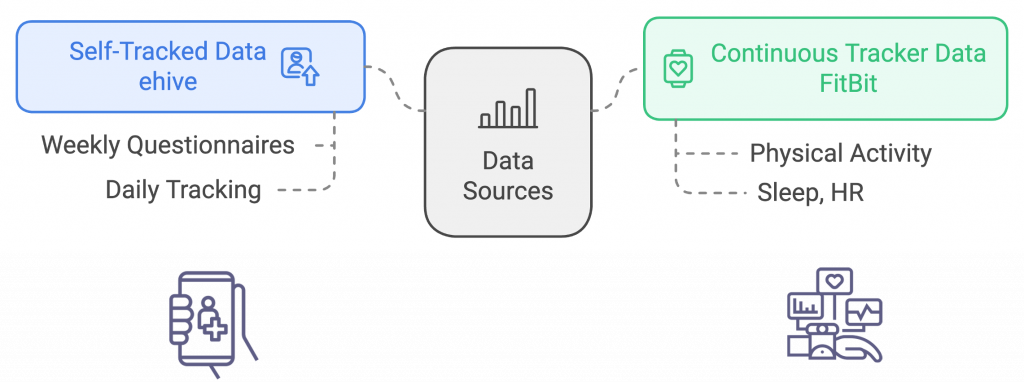
Daily Check-Ins, Weekly Surveys, and Fitbit: What Each Tells Us About CPP
CPP Tracker asks about your pain, activities, sleep, mood, and other symptoms at different time points—some questions are daily, some weekly, and some of the information comes from your Fitbit. Each of these pieces does something slightly different. Short daily questions catch the ups and downs: the sudden flares, the “good days,” and the in-between days you might otherwise forget. Weekly questions zoom out to look at the bigger picture: how much CPP is affecting work, relationships, or getting through routine tasks. Fitbit data fill in the background with more granular information on how you are moving and sleeping when pain spikes or calms down, without you having to remember all the details later.
Designing CPP-Specific Digital Measures for Clinical Usability
Behind the scenes, we are using these answers and signals to build and test new CPP-specific questions. In research terms, these are called “patient-reported outcome measures (PROMs),” but in practical terms they are structured ways of turning your experience into numbers and patterns that doctors and researchers can actually act on. We are not just trying to make pretty charts; we are checking whether these questionnaires are truly capturing what life with chronic pelvic pain is like, and whether shifts in your scores line up with real changes you feel in your body and daily life.
To our knowledge, this study is the first to be fully designed around creating and validating PROMs based specifically for female chronic pelvic pain disorders, rather than borrowing tools made for other conditions and hoping they fit. That means we are paying attention to things like pelvic pain with sex, bladder and bowel-related symptoms, and the unpredictable timing of flares—issues that are often sidelined or oversimplified in more generic pain scales. When the tools are not built for CPP, important details can be lost, which makes it harder to diagnose accurately and tailor treatments. The goal is to build tools that “speak the language” of CPP instead of forcing your experience into boxes that do not quite fit. So how could this actually change a clinic visit for you?
CPP Tracker | Ensari Lab
Imagine going to an appointment and, instead of trying to summarize the last three months in two minutes, your clinician has a clear, summarized view of your data from CPP Tracker. They can see when your pain is worst during your cycle, how often flares are happening, how they affect sleep and activity, and which treatments you were trying at different times. You are no longer stuck saying “It’s been kind of up and down”; you can point to specific patterns, like “My pain scores have been creeping up over the last six weeks, and you can see I have been sleeping less on those nights too.” Seeing those patterns laid out in simple scores and trends can make it easier for you to make sense of what has been happening, not just for your clinician.
Or picture a follow-up visit after starting a new medication or pelvic floor therapy. Instead of “I think it might be helping?” your CPP-specific scores can show whether your pain intensity, interference with daily activities, or pain with sex have actually changed over the course of treatment. If your scores improve but you still feel stuck in one area—say, you are moving more but sex is still painful—that helps focus the conversation. Your clinician can see where things are better and where you still need more targeted support, rather than guessing or relying only on vague impressions.
These measures can also help you be taken more seriously. Many people with chronic pelvic pain have had the experience of being dismissed or told that their symptoms are “just stress” or “in your head.” Walking into a visit with clear, disease-specific scores and trends is not a magic fix, but it gives you something concrete to stand on. Instead of arguing about whether your pain is “that bad,” the conversation can shift toward “Given how high these scores are and how long they have stayed this way, what are our next diagnostic or treatment steps?”
d2prom Study – Design and validation of digital PROMs for physical therapy for chronic pelvic pain patients.
Why Validating Digital PROMs for CPPD Matters
Over time, as more patients use CPP Tracker, these data can help clinicians recognize different “patterns” of CPP—who tends to flare with certain triggers, who responds to which treatments, who might need earlier referrals or more intensive care. That has the potential to support earlier detection of problems that are usually missed, fewer years of bouncing between referrals without answers, and more individualized treatment plans. And because these patterns are shown back to you in simple scores and trends, they can also help you see connections in your own symptoms and triggers. So when CPP Tracker sends you another daily check-in or asks you to sync your Fitbit, you are helping build the evidence base that could improve care for the next person who walks in with similar symptoms.
The purpose is to build a measurement system that actually fits chronic pelvic pain, and to put that system to work in exam rooms—so that your story is clearer, your needs are harder to ignore, and your care has a better chance of matching what you really live with day to day. We are deeply grateful for your time, your interest, and your participation in this work. Truly, none of this research would be possible without you.