
How tracking at a consistent time each day helps participants — and our research
When we ask participants to complete daily check-ins through our app, a natural question comes up: does it matter when I fill these out? Maybe you’re a morning person who likes to start the day by logging how you feel. Maybe you squeeze it in during lunch. Or maybe it’s the last thing you do before bed.
Here’s what surprised us when we looked at the data: it doesn’t matter when you track. What matters is that you do it at roughly the same time each day. So those reminders you set up for yourself only matter if you are actually able to consistently do it at that time.
We analyzed over 14,000 daily check-ins from 218 study participants — including both women living with chronic pelvic pain conditions (CPPDs) and those without three months. We wanted to understand what separates participants who consistently track their health in the ehive App from those who gradually fall off. Is it pain? Pain-related interference with daily activities? Or is it something else?
The answer wasn’t pain severity or motivation, or the time of the day the survey is being completed, but instead, consistency. As depicted in Figure 1 below, participants who tracked at a regular time each day completed their check-ins 92% of the time. Those whose tracking times jumped around showed only 63% consistency. Interestingly, that 30-percentage-point gap held true whether or not someone had chronic pain.
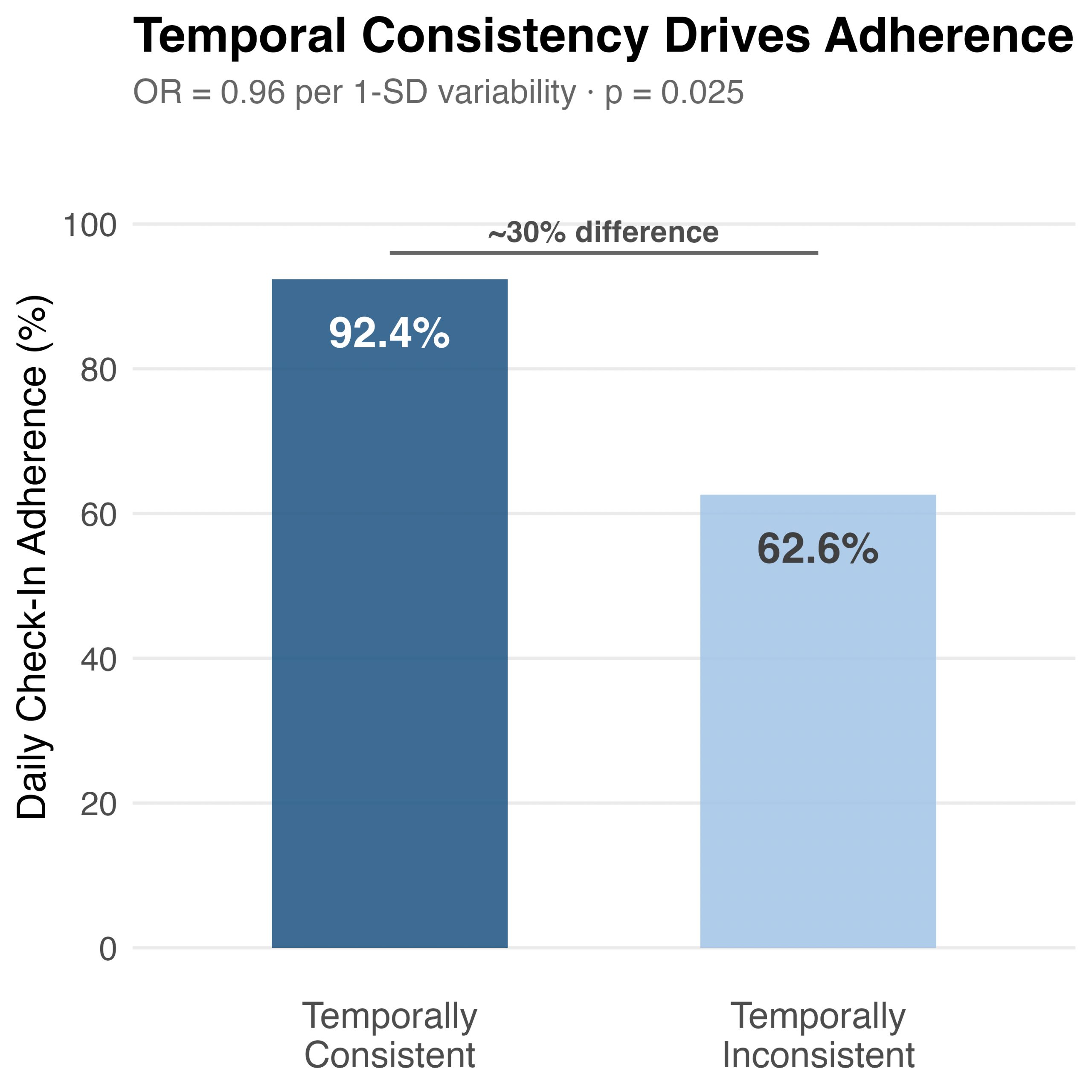
We also learned that the time at which you complete the surveys doesn’t actually matter as much as staying consistent in that time. We were curious for our daily check-in survey: what time are people completing this? I’m a morning person myself so I feel like I would do it first thing when I’m up before the day gets busy, but I am definitely not the norm.
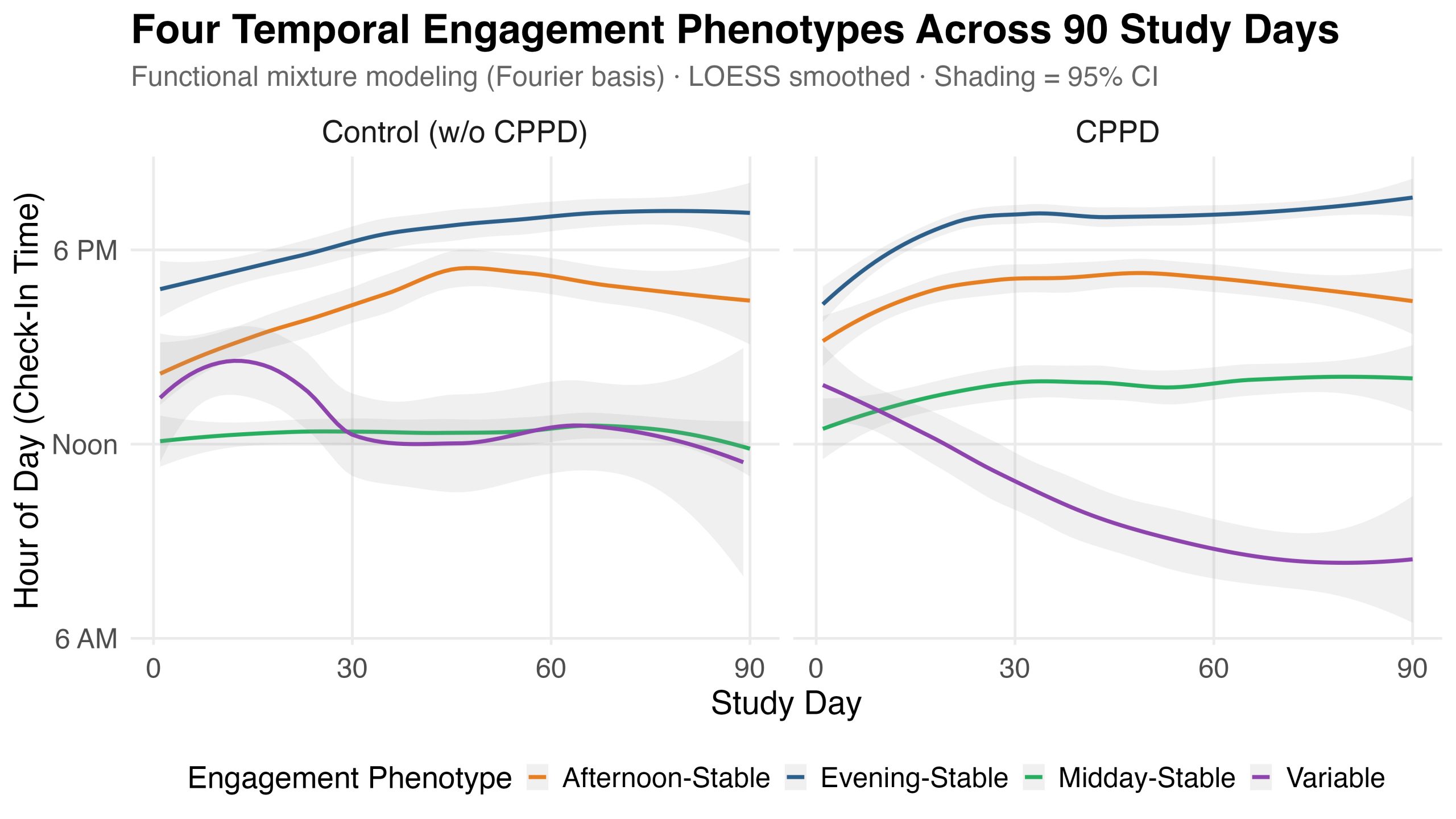
To answer this question, we used a data technique called unsupervised learning and functional mixture modeling, which sorts the participants into naturally-emerging groups or “profiles”. This revealed four distinct tracking patterns based on the data. Some people consistently tracked in the morning, some in the afternoon, some in the evening, and some were variables across all 3 time periods.
We refer to the first of these groups “the evening-stable group”, aka. people who consistently tracked in the evening (navy blue line in Figure 2). They had 88-90% adherence regardless of whether they had a CPPD or not. But the key word there is consistently. Morning and afternoon trackers who stuck to their routine also did well (orange and green lines in Figure 2).
The Variable group (purple line in the figure), no matter when they happened to track on any given day, lagged behind. As you can see in the graph below (Figure 2), having a CCPD or not did not define if you were doing the surveys or not, it was the fact that people stuck with a time of day and continued doing their surveys during that time, which kept their responses stable.
Why does this matter?
Every check-in that is completed enables a more complete picture of how symptoms like pain, sleep, mood, and mobility change from day to day. When data are missing, it’s harder to spot patterns and understand the individual experience. If people only fill out a survey when they’re feeling particularly bad (or particularly good), the data tell a skewed story. However, consistent daily tracking even on the boring, nothing-special days gives the full picture and allows us to get an overall picture of health.
This is also one of the key differentiators of research studies – we collect new data designed specifically to answer these research questions, in collaboration with our participants. This is in contrast to the “User Terms & Agreement” you might come across in many Apps, which can use your data retrospectively to answer a wide range of questions instead. When you enroll in an academic research study, you are kept informed and consented at every stage during your involvement in the study.
A take-home from these results
So participants don’t need to set an alarm for 7:00 AM sharp. Finding the right time of the day that works for each individual is what creates a habit of consistency. Some time periods to think about when setting up reminders for survey completion can be from below:
- Morning: Right after your first coffee or tea
- Afternoon: During a lunch break
- Evening: Right before you wind down for bed
If you are curious to learn more about these analyses, check out our paper that will be presented at the upcoming CHI Conference in Barcelona, Spain!