
The Pondering Professor – Reflections on digital data and trust from PI Ipek Ensari
Every time we run a study, we are asking people to let us into some of the most personal parts of their lives: their symptoms, their routines, their bodies’ signals. As the study team for CPP Tracker, and our other studies, we take this invitation and the trust behind it very seriously. In digital health research, where we rely on apps, wearables, and smartphones to collect data in real time, consent can feel like one more hurdle. It is therefore natural for many people to hear “research consent form” and think “a stack of paperwork between me and the real study.” From our side of the table, consent is not an obstacle. It’s the moment where we decide, together, whether the study has earned your trust.
What research consent is really for
At its core, the consent process is about helping you decide whether joining a study is right for you. It’s not about persuading you. It’s about giving you enough clear, honest information so you can make a decision you feel good about. A successful consent conversation and form should answer a few basic questions:
-
What is this study about, and why are you doing it?
-
What would I actually be doing if I join?
-
What kinds of information will you collect about me?
-
What are the possible risks or inconveniences?
-
Who will be able to see my information?
-
Can I change my mind later?
If you’ve gone through the consent materials, asked your questions, and still feel unsure, to me that’s a sign we have more work to do in how we explain things, not that you “weren’t paying attention.”

In CPP Tracker and our other digital health studies, we treat informed consent as a step‑by‑step conversation, not a single checkbox.
Why consent is more than a signature
Yes, in most cases we do need a signed consent form before we can enroll you. But consent is supposed to be a process, not a piece of paper. For me, that means:
-
Using language you don’t need a medical degree to decode.
-
Leaving room for your questions, not rushing you through.
-
Being transparent about what we know and what we don’t know yet.
-
Making it absolutely clear that “no” is an acceptable answer.
I think of consent as setting expectations for a relationship. I’m asking you to share sensitive information about your symptoms, your daily life, and sometimes your body’s data from wearables and smartphone apps. In return, I owe you clarity, respect, and honesty about what we’re doing and why.
How research consent differs from app “terms and conditions”
It can be tempting to lump research consent together with those long “I agree” pop‑ups you scroll through when you start using a new app or wearable. On the surface, they look similar: lots of text, some legal language, a signature or a click at the end. But they are not doing the same job. Most user agreements are written to spell out what a company is allowed to do with your data and its product. In research, the goal is different: we’re trying to help you understand what will happen if you join, what we’ll ask of you, how we’ll protect your information, and what your rights are as a participant in a study. That’s why, in our work, we treat consent as a conversation, not a checkbox. You should feel like you can say “I need more time,” “I don’t understand this part,” or “I don’t think this is for me” without worrying that you’ll lose access to care or services. From an ethics point of view, that’s part of informed consent. From my point of view as a PI, it’s also part of basic respect.
Why digital health studies need especially clear consent
Digital tools, like apps, wearables, phone‑based sensors, can give us rich, continuous information we simply cannot get from a single clinic visit. That’s exactly what makes them so powerful for understanding conditions like chronic pelvic pain and other women’s health issues. But the same features that make them powerful also make it even more important to be clear and up front about data use and privacy.
In digital health:
-
Data can be collected frequently (for example, daily symptom reports).
-
Some data may be captured passively (such as step counts or sleep patterns).
-
A lot of this happens outside the clinic, in the middle of your real life.
People are often less familiar with how this kind of data flows through a research study than they are with a traditional paper questionnaire. That’s why, when we design and run studies, we try to be explicit about:
-
What the app or tool does and what it does not track.
-
How often we plan to ask for your input.
-
What kinds of patterns we’re hoping to understand in your symptoms and daily life.
-
How we plan to protect and use that information once you share it.
My goal is that you’re never left guessing about what’s happening behind the scenes with your health data in our studies.
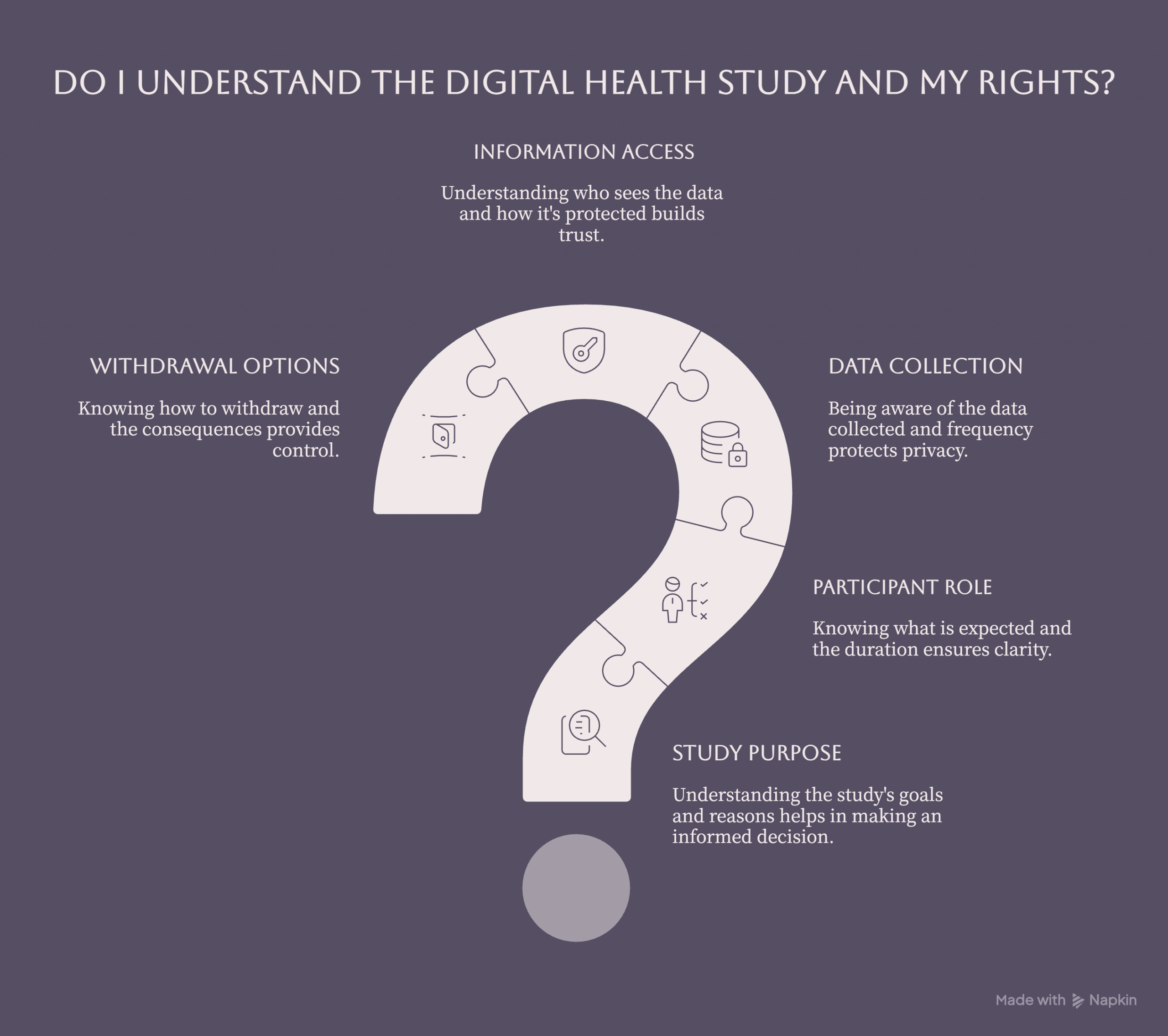
A good informed consent process in digital health research should make it easy to answer these questions before you decide whether to join.
How this plays out in CPP Tracker
In CPP Tracker, we ask participants to report symptoms and related experiences over time. Chronic pelvic pain is not a one‑size‑fits‑all condition; it fluctuates, it clusters with other symptoms, and it interacts with daily life in ways a single doctor’s visit simply cannot capture. That’s why this study lives on your phone, not just in the clinic. When you’re considering whether to join CPP Tracker, the consent process should give you a clear picture of things like:
-
What kinds of questions we’ll ask (for example, about pain levels, mood, or activity).
-
How often we might send you prompts or reminders.
-
How long your participation would last.
-
Whether we use any data from wearables or phone sensors, and if so, which ones.
-
How we plan to use your responses to better understand chronic pelvic pain over time.
From our side, every “yes” is a real act of trust – that you’re willing to let us into the private realities of your symptoms and your day‑to‑day life. The consent process is where we either earn that trust, or we don’t.
What good consent should feel like
My personal benchmark as an investigator is that a good consent process should leave you feeling informed, not pressured; clear, not confused; and free, not boxed in. If you can honestly say:
-
“I know what they’re doing.”
-
“I know why they’re doing it.”
-
“I know what it means for me, and I’m okay with it.”
then we’re closer to doing our job well. And if you decide the study is not right for you, that is still a successful outcome of the consent process. It means the information was clear enough for you to make the decision that fits your life and your values.
Closing: The Pondering Professor Corner
This post is the first in our short series The Pondering Professor Corner about how we think about your data, your trust, and your participation in digital health research. Here we stayed at the moment of decision: the consent form, and what we are asking of you when we invite you into a study like CPP Tracker. In the next post, I’ll pick up the story from there and walk you through the “life” of your data once you decide to join, such as where it goes, who sees it, and what we do (and don’t do) with it in a digital health context. Because digital health research depends on participant trust, and trust depends on clear communication.
—
About the author: Ipek Ensari, PhD, is an Assistant Professor at the Icahn School of Medicine at Mount Sinai Department of AI and Human Health and principal investigator of the CPP Tracker study on chronic pelvic pain. She is a digital health researcher focused on gynecological pain disorders like endometriosis, adenomyosis, and fibroids, wearable and app-based data, and AI-driven methods, with a particular interest in health data privacy, informed consent, and participant-centered study design.