
We have exciting news to share! Our research team at the Icahn School of Medicine at Mount Sinai has just published a new peer-reviewed scientific study in the journal npj Women’s Health.
Led by Dr. Jens Jegminat, this study uses the Fitbit data from our participants to build personal forecasting models that learn your daily routine. By spotting those patterns early, the model can predict when you are about to sit still for a long stretch before it actually happens. That opens the door for timely, personalized reminders to stand up, stretch, and take a mini movement break.
Why Timing Matters Most
We all know we should move more throughout the day. But standard fitness trackers usually tell you what you’ve already done. The real challenge is catching a long period of sitting before it starts, not hours after you’ve been in your chair.
Even brief movement breaks can big health benefits. For example, research suggests that adults who take a brief two-minute walking break every 20 minutes significantly lower their blood sugar and insulin levels after meals compared to those who remain seated.1
For individuals living with chronic pelvic pain, “just move more” is often easier said than done. Daily pain and fatigue can make physical activity challenging, even though gentle, short bursts of movement can help manage symptoms. We wanted to see if a wearable could look ahead instead, offering support at the right moment without buzzing on your wrist all day long.
How the Wearable Learns Your Routine
The Fitbits worn in our study recorded physical activity minute by minute. We converted each minute into a simple physical activity score ranging from 0 (sitting still) to 1 (highly active). Using just the first 10 days of a person’s data, our system created an individualized movement forecast.
So, how does a wearable “learn”? It looks for daily patterns, much like a weather forecast.
A weather forecast model analyzes recent atmospheric conditions alongside seasonal trends. Our model does the same thing with physical activity: it evaluates how active you’ve been over the past several hours and compares it to your usual routine for that time of day. For instance, if you typically sit down at your desk around 2:00 p.m., the forecast notices that pattern. The advanced model can continually update and adapt as new data comes in.
Hour by hour, the model estimated upcoming activity, and we checked every guess against what actually happened. We uncovered two practical findings:
- Simple models worked just as well as complex ones: This is great news for privacy. Simple models require less processing power, meaning they could one day run directly on your smartwatch or phone without needing to send your personal data to external servers or the cloud.
- The forecasts remained reliable even with missing data: The model held up seamlessly when participants took off their Fitbits to charge or missed a sync.
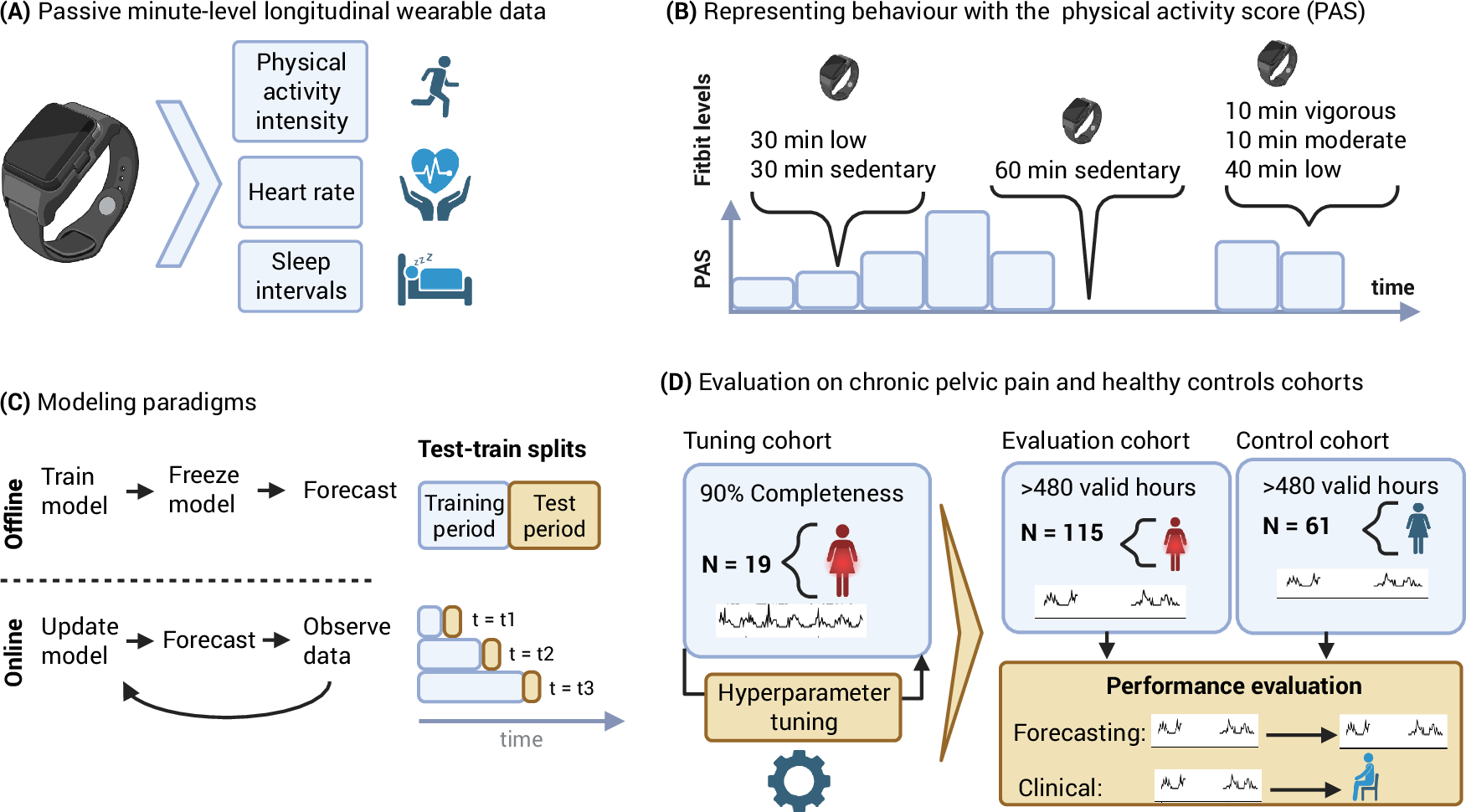
Figure 1: Overview of our sedentary behavior forecasting framework. Minute-by-minute wearable data (A) is converted into activity scores (B) to train both offline and online forecasting models (C). These models were evaluated across participants with chronic pelvic pain and healthy control cohorts (D) to ensure accurate, real-time predictions. (Image source: Jegminat et al., npj Women’s Health, 2026)
Powered by Real-World Data
Research like this is only possible thanks to the dedication of study participants and the broader patient community. Every time a participant wore their Fitbit, synced their device, or put it back on after charging, they contributed valuable science. In total, 134 women living with chronic pelvic pain shared up to 90 days of Fitbit data, alongside 61 participants without pelvic pain.
These data reflect actual daily routines: workdays, weekends, restful days, and painful days. Therefore we were able to design and test solutions that work in the real world, not just in a controlled laboratory setting. Chronic pelvic pain affects approximately 1 in 7 women in the U.S., yet it remains historically understudied.2 Your participation helps close that research gap.
What’s Next?
So far, we have tested these models on past data, so no live reminders were sent. A next step would be to build this into what is called a “just-in-time adaptive intervention” (or JITAI – as in Jedi). JITAIs deliver supportive nudges at the exact moment they are needed. Imagine receiving a gentle notification to stand up or stretch right before a long sitting period begins, giving you timely support to manage your physical well-being without notification overload.
From there, we will measure whether these timely nudges actually help people sit less, feel better, and manage symptoms. We want it to feel like helpful, practical support for your health without feeling intrusive or overwhelming. Down the road, we hope this same approach can support people living with other chronic conditions where long periods of sitting affect daily well-being.
Thank You!
To everyone who wore a tracker, synced their data, or supported our work: thank you. You are helping shape research that matters for people living with pelvic pain.
Samia Shahnawaz, MPH | Department of AI and Human Health, Icahn School of Medicine at Mount Sinai
This research was supported by the Eunice Kennedy Shriver National Institute of Child Health and Human Development (NIH Award R01HD108263, PI: Ensari) and the National Center for Advancing Translational Sciences (CTSA grant UL1TR004419).
References
- Dunstan DW, Kingwell BA, Larsen R, et al. Breaking up prolonged sitting reduces postprandial glucose and insulin responses. *Diabetes Care*. 2012;35(5):976–983.
- Mathias SD, Kuppermann M, Liberman RF, Lipschutz RC, Steege JF. Chronic pelvic pain: prevalence, health-related quality of life, and economic correlates. *Obstetrics & Gynecology*. 1996;87(3):321–327.
Full citation: Jegminat J, Shahnawaz S, Rodrigues J, Danieletto M, Landell K, Campanella G, Garber CE, Fayad ZA, Ensari I. Robust forecasting of sedentary bouts in chronic pelvic pain disorders for on-device learning and real-time deployment. *npj Women’s Health*. 2026;4:30. doi:10.1038/s44294-026-00156-5