
Data Bytes | Samia Shahnawaz, Data Analyst II
Welcome back to Data Bytes!
If you’ve participated in our studies recently, you might have noticed that we tend to have some repeated questions across all the surveys. For example, we ask about your sleep in more than one place, and we also collect sleep from your Fitbit. Why isn’t one measurement enough? We explore this question in today’s blog post.
Having “good sleep” isn’t one thing. How your sleep felt last night, how disrupted it felt overall, and how many hours a wearable device like your Fitbit or Apple watch estimated you were asleep can each tell a different part of the story. When we put those data streams side by side in our studies, we can get a more comprehensive and accurate picture of sleep.
This matters even more if you check a sleep score on a Fitbit, Apple Watch, Oura, or another wearable. It’s easy to treat that number like a gold standard for sleep health. But what if your sleep score (or your estimated sleep hours) looks fine but you still feel as if your sleep was not refreshing? Duration alone does not equal refreshing sleep. You can be “asleep” for eight hours and still spend much of the night tossing and turning, waking briefly, or never settling into deep rest. Those nights often feel different the next day even when the clock (or the device) says you got enough hours asleep.
Three reads on the same night (and week)
For example, in our D2PROM study, we look at sleep in at least three formats:
- The daily check-in has the questions “How would you describe your sleep last night?” and “Last night my sleep quality was…”
- Weekly PROMIS Sleep Disturbance is a short questionnaire about how disrupted, unrefreshing, or difficult sleep felt over the past week
- Fitbit passively estimates sleep duration (and related signals such as movement and heart rate during the night)
If one of those were the “ground truth,” the others would mostly be redundant. However, in practice, they fill in different pieces. Research outside our study has demonstrated that what people say about their sleep doesn’t always line up with what a wearable device or a sleep study records, especially when sleep feels poor.¹˒² Feeling unrested and logging a lot of hours can both be true at the same time.
What a device “sleep score” is actually scoring
Therefore, sleep scores you get from your tracker aren’t as reliable as you might think. Across every wearable brand, the calculations are done a little differently. On Fitbit / Google Health, for example, the 0–100 score mixes a few things together: how long you slept, how quickly you seemed to settle in, how steady the night looked, how restless you were, and whether you had longer wake-ups.³ Hours matter a lot in that mix, but so does whether the your sleep cycles and other factors were also optimal.
That’s helpful to know and explains why you can still receive a high score when you feel wrecked, or look “low” when you feel fine. The watch is usually picking up movement, timing, and signals from your wrist. It is not asking about pain, stress, mood, pelvic symptoms, or whether you woke up feeling restored. Moreover, there could be measurement errors. Studies that compare wearables next to questionnaires usually find only a weak-to-moderate match because they’re measuring related things, not the same thing.⁴˒⁵ Indeed, Fitbit’s own help pages say that if you feel rested but received a lower than expected score, trust your body over the score.³
What happens when we put them next to each other
We looked at D2PROM survey and Fitbit data together in two ways: matching each daily check-in to last night’s Fitbit sleep, and matching the weekly sleep questionnaire to that same week’s Fitbit nights.
1. Daily sleep ratings vs Fitbit sleep hours
For the daily analysis, we took people’s answers to “Last night my sleep quality was…” and grouped it into three buckets: poor/very poor, fair, and good/very good. Then, we looked at the Fitbit sleep hours for that same last night (the night that had just ended when they answered). For each bucket, we show the typical Fitbit hours the middle value, or median, across about 1,600 matched check-ins.
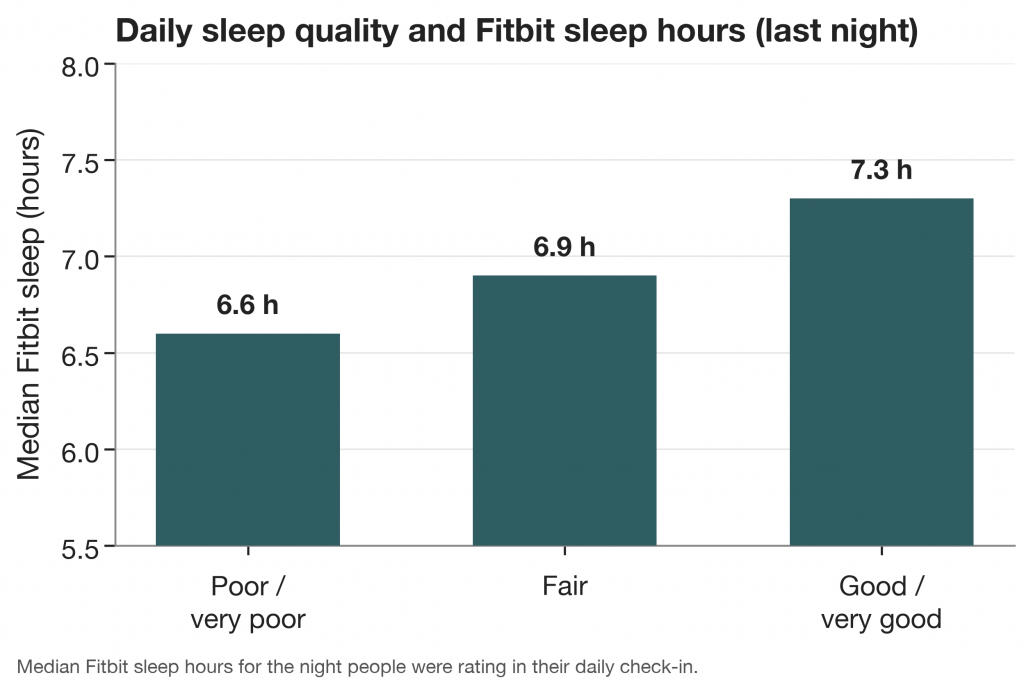
Figure 1. Daily sleep quality and median Fitbit sleep hours for last night
Here’s the part that jumps out: Fitbit hours barely moved across how sleep felt. Poorer nights were around 6.6 hours, and better nights around 7.3 hours. That’s less than an hour apart, even though people were describing nights that felt very different. In short, you could sleep roughly the same amount of time each night but wake up feeling varying levels of refreshed.
That makes more sense once you know what a wristband is good at. Fitbits are great for spotting sleep trends over time, but laboratory sleep studies report that they often count quiet time in bed as sleep, including lying still while you’re actually awake.⁶ So if a sleep score leans hard on “hours asleep,” it can look reassuring on a night that still felt restless or unrefreshing.
2. Weekly PROMIS sleep vs Fitbit sleep hours
For the weekly view, we used the PROMIS Sleep Disturbance questionnaire (higher scores mean more disrupted sleep) and split weeks into better, middle, and worse sleep weeks. For the same study week, we took each person’s typical Fitbit sleep hours across nights with data (at least 3 nights). That gave us 337 person-weeks from 39 participants.
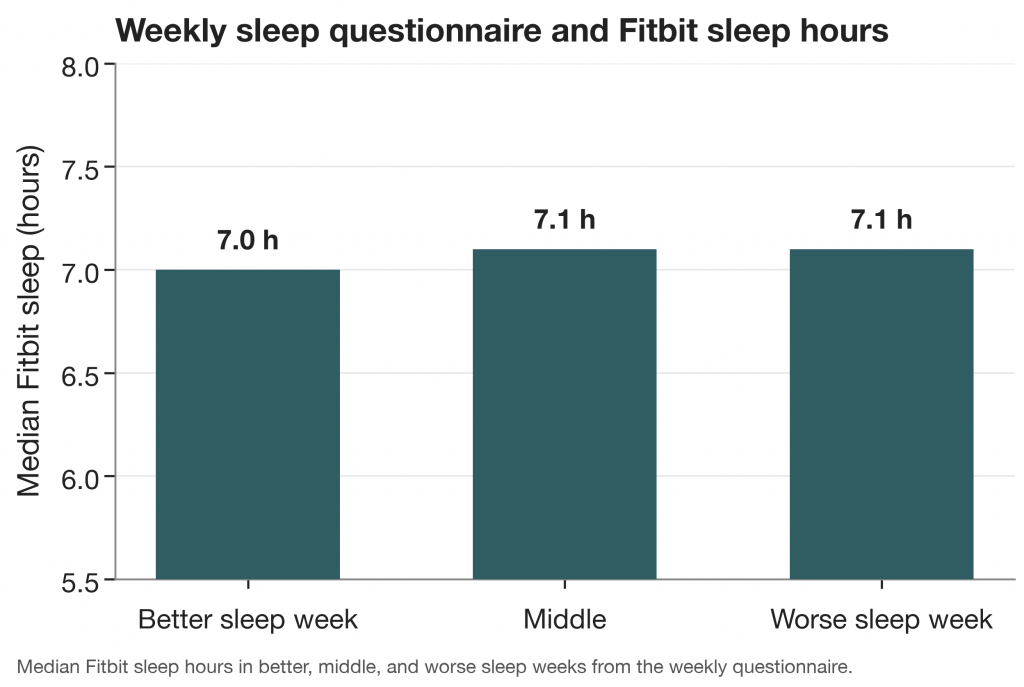
Figure 2. Weekly sleep questionnaire and median Fitbit sleep hours (same week)
Across better, middle, and worse sleep weeks, Fitbit hours stayed almost flat, about 7.0 to 7.1 hours. Weeks that felt much more sleep-disturbed did not show a matching drop in how long the Fitbit said people slept.
So whether we look day-by-day or week-by-week, the pattern is the same: how sleep felt and how many hours the Fitbit counted are only loosely linked so far. A “fine” number of hours is not the same as a refreshing night.
This is why one measurement isn’t enough.
Each format answers a different question:
- Daily check-in asks: How did last night feel, in the moment?
- Weekly PROMIS asks: How disrupted has sleep been across the week, instead of a daily check on it.
- Fitbit asks: What did the device estimate for sleep duration (and related overnight signals it can sense)?
In D2PROM so far, how sleep felt and how many hours the wristband counted do not tell the same story. If we only used Fitbit hours or sleep scores built partly from those hours, we might conclude that “bad sleep weeks” and “good sleep weeks” look similar and miss that people were describing much more disturbance when sleep felt worse. If we only used a weekly survey, we’d lose the night-to-night texture the daily check-in captures. If we only used the daily question, we’d miss a validated weekly sleep-disturbance scale that researchers use to compare across studies.
This is also why the research literature talks about subjective and device-based sleep as linked without treating them as interchangeable. Wearable sleep metrics and patient-reported sleep quality often disagree, especially in people with insomnia or other clinical sleep complaints; objective length and stages do not fully explain how restorative sleep felt.¹˒²˒⁴˒⁵ This makes it hard to define your overall sleep and rest as a single score. So what we do in our studies is ask in multiple formats, as well as pull Fitbit data, not to be redundant, but because one channel can miss what another catches.
This is why your sleep score is worth glancing at but shouldn’t be the end all score you rely on. They are useful for assessing trends over time, but not for making conclusions based on 1-2 nights. We thank you for helping us unearth these patterns; the combination of daily check-ins and wearables is what let’s us see when measures agree, when they don’t, and what that means for understanding life with pelvic pain.
References
¹ Herzog N, et al. The (mis)perception of sleep: factors influencing the discrepancy between self-reported and objective sleep parameters. J Clin Sleep Med. 2021. https://pmc.ncbi.nlm.nih.gov/articles/PMC8320481/
² Discrepancies between subjective insomnia severity and Fitbit-based sleep measures. JMIR Mental Health. 2025. https://mental.jmir.org/2025/1/e67478
³ Google Health Help. What’s the Sleep Score in the Google Health app (Fitbit sleep score components: duration, time to sound sleep, sound sleep, restlessness, interruptions, full awakenings). https://support.google.com/googlehealth/answer/14236513
⁴ Concordance of wearable device sleep metrics with patient-reported sleep quality: A systematic review. PubMed. https://pubmed.ncbi.nlm.nih.gov/41946254/
⁵ Assessment of Subjective and Objective Sleep Quality from Wrist-Worn Wearable Data. IntechOpen. https://doi.org/10.5772/intechopen.1006932
⁶ Haghayegh S, Khoshnevis S, Smolensky MH, Diller KR, Castriotta RJ. Accuracy of Wristband Fitbit Models in Assessing Sleep: Systematic Review and Meta-Analysis. Journal of Medical Internet Research. 2019;21(11):e16273. https://www.jmir.org/2019/11/e16273