
Disease Interception and Prevention
IBD begins years before symptoms appear. The lab studies people at high risk for IBD, including multiplex families and first-degree relatives of patients, and integrates genomic, microbiome, metabolomic, and immunologic data to characterize the preclinical phase of disease. Supported by an NIDDK K23 Career Development Award, this work forms the foundation of the Mount Sinai IBD Prevention Program and the world’s first dedicated IBD Prevention Clinic, the primary site for the Helmsley-funded PROMISE/PREDICTS consortium.

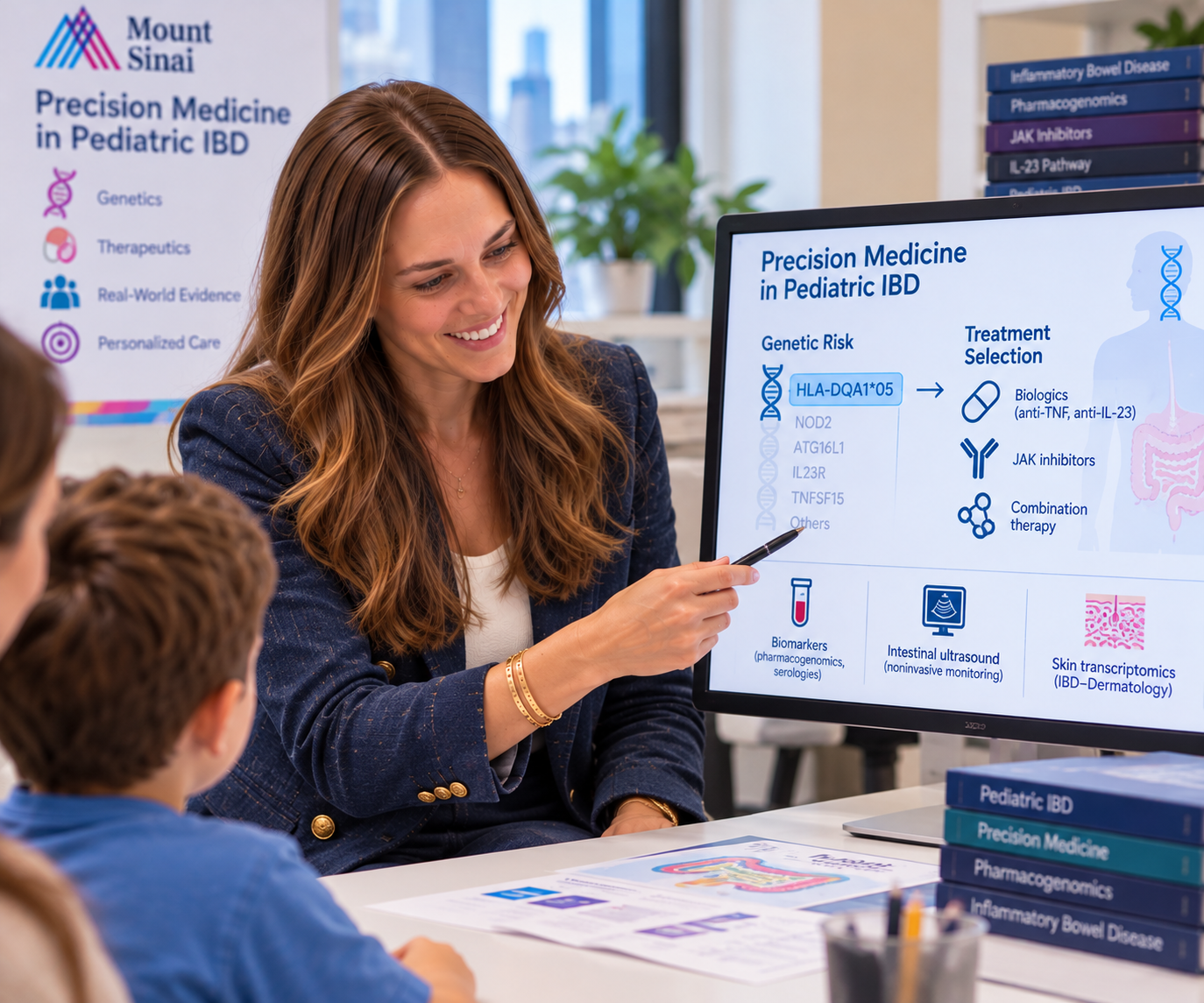
Precision Medicine in Pediatric IBD
For children living with IBD, the lab studies how to match the right therapy, at the right dose, to the right patient. This work spans therapeutic drug monitoring, pharmacogenomics, and biomarker-driven treatment selection. Through the IBD-Dermatology Multidisciplinary Clinic, the lab also uses skin tape strip transcriptomics to define immune signatures across IBD and related immune-mediated diseases.
Intestinal Ultrasound and Noninvasive Monitoring
Intestinal ultrasound (IUS) allows real-time, noninvasive assessment of disease activity at the point of care. The lab develops workflows that integrate IUS into routine pediatric care and clinical trials, studies IUS as a treat-to-target monitoring tool, and helps lead national efforts through the NASPGHAN Intestinal Ultrasound Special Interest Group and the Intestinal Ultrasound Group of the United States and Canada (iUSCAN).


Real-World Evidence for Treatment and Monitoring
Many advanced therapies are used in children before pediatric trials are complete. The lab generates real-world evidence to guide their use, leading national and international multicenter studies of novel and off-label therapies in pediatric IBD, including risankizumab, upadacitinib, subcutaneous infliximab, and combination advanced therapy. Through the New Drug Start Program, which standardizes monitoring and data capture for patients starting new therapies, and large-scale electronic health record analyses using Epic Cosmos, the lab also studies how children are monitored after starting treatment and how that care can be made more consistent.
Featured Study: COMPARE
COMPARE (Clinical Outcomes of Medications Post Anti-TNF: Researching Effectiveness in Pediatric IBD) is a PCORI-funded multicenter study evaluating the effectiveness of medications used after anti-TNF therapy in children and adolescents with IBD. Dr. Spencer serves on the study’s Core Clinical Leadership Team as the Northeast (INSIGHT) region lead and on its Study Planning Committee, leads the Mount Sinai site, and leads the COMPARE intestinal ultrasound substudy.
Learn more at compareibd.org | ClinicalTrials.gov: NCT07198113
Clinical Trials
The lab participates in multicenter pediatric trials of emerging IBD therapies, including studies of mirikizumab in pediatric ulcerative colitis and Crohn Disease, risankizumab in pediatric Crohn Disease, upadacitinib in pediatric ulcerative colitis and Crohn Disease, IL-23 inhibition (MACARONI-23), and vedolizumab combination therapy (VICTRIVA).
Funding
- NIH/NIDDK K23 Career Development Award (K23DK125760): The Microbiome, Metabolome, and Genome in Multiplex IBD Family Clusters
- Leona M. and Harry B. Helmsley Charitable Trust: Defining the Pre-Disease Phase of Crohn Disease: Predict and Prevent (PROMISE/PREDICTS)
- PCORI: Clinical Outcomes of Medications Post Anti-TNF: Researching Effectiveness in Pediatric IBD (COMPARE)
- NCATS: Developing a Scalable Clinical Monitoring Platform to Support and Evaluate Translational Interventions in Inflammatory Bowel Disease